Shoulder
Range. Then strength.
We map the missing range before we load it. No cortisone cycles. No permanent modifications. A real path back to overhead.
A rotator cuff tear on your MRI is not an automatic surgery: tears show up in roughly 1 in 4 pain-free adults, and randomized trials show structured rehab matches surgical repair for most non-traumatic tears. Most shoulder cases at Physio+ resolve inside 8 to 12 weeks of progressive loading and scapular work, and night pain is usually the first symptom to go.
Possibly, and often it matters less than it sounds. Rotator cuff tears appear in roughly 1 in 4 adults with no shoulder pain at all, and in about half of pain-free shoulders past 80. In a Finnish randomized trial of non-traumatic tears, physical therapy alone matched surgical repair at 2 years.
Torn sounds like a rope about to snap. Cuff tendons do not work like rope. Most tears are gradual, partial, and shared by millions of comfortable shoulders: in a Japanese mass-screening study, about two thirds of the tears found belonged to people with no symptoms. What usually hurts is not the tear itself but the pattern around it, a weak cuff and a lazy shoulder blade forcing irritated tissue to do work it is not conditioned for. That pattern trains.
The honest exception: a sudden full-thickness tear after real trauma, a fall or a hard jerk, with new weakness you can feel. Younger, active patients with that story do better with an early surgical opinion, and we will tell you on day one if that is your exam. For everyone else, the evidence says load the shoulder before anyone cuts it.
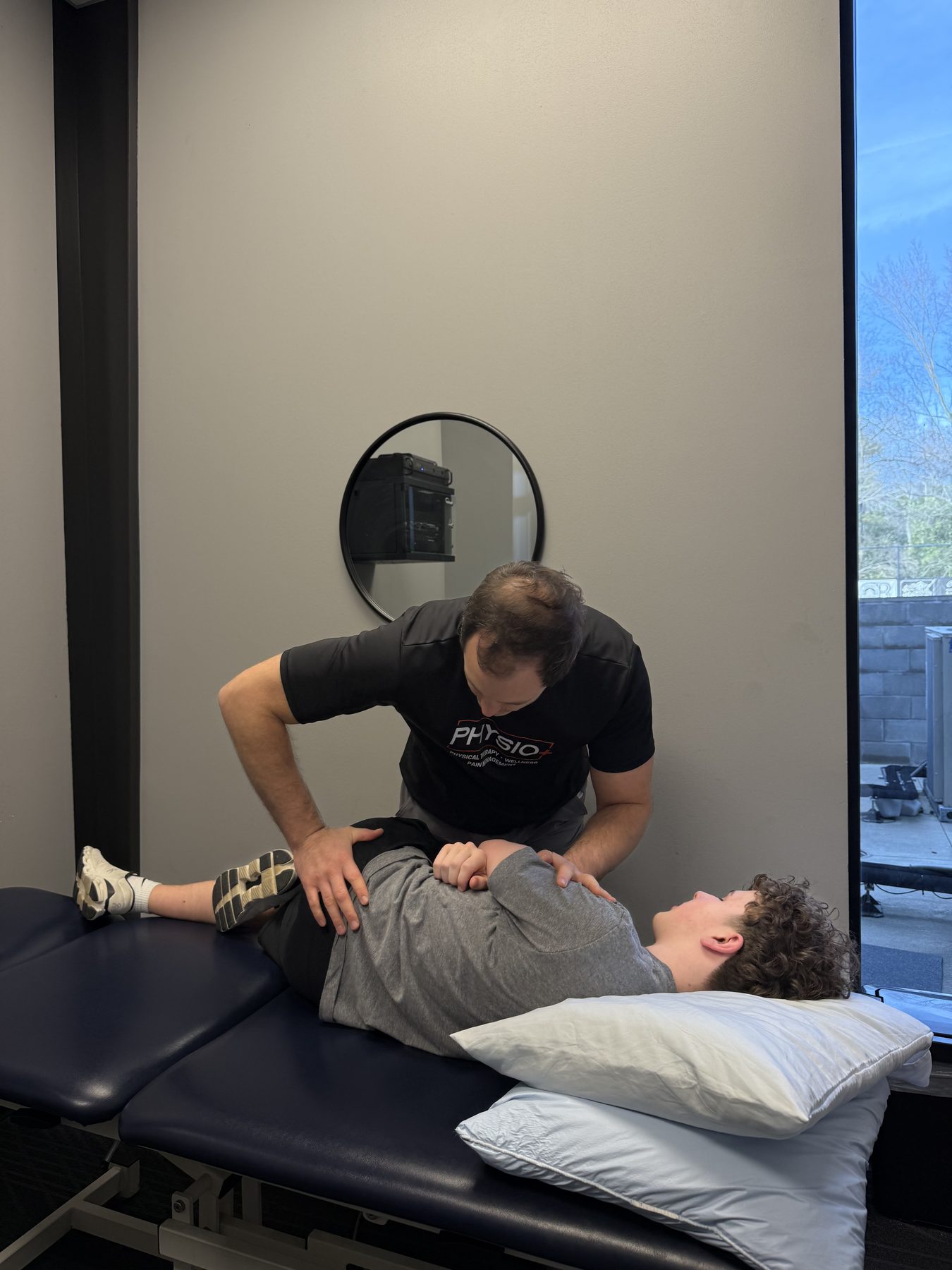
A Physio+ shoulder evaluation takes 60 minutes with a doctor of physical therapy: range, strength testing, special tests, and watching how your shoulder blade actually moves. Plans combine manual therapy, progressive cuff and scapular loading, dry needling for the guarded upper trap and infraspinatus, and shockwave therapy for chronic tendon cases. Wondering whether your shoulder even needs an appointment yet? Our guide on when shoulder pain warrants a PT gives you the decision rules, and the complete shoulder pain guide goes condition by condition in depth.
Side sleeping compresses the cuff and its bursa directly, and lying flat lets fluid settle in tissue that worked all day. Night pain is the signature complaint of rotator cuff irritation and frozen shoulder, it is usually the first thing rehab improves, and there are positions that buy relief this week.
The short-term fixes are positional. Sleep on the unaffected side hugging a pillow so the sore arm rests supported in front of you, or on your back with a small pillow under the elbow so the arm does not fall into the position that pinches. A quarter turn back from a full side-lying position takes direct pressure off the cuff. None of this heals anything, but stringing together full nights changes how fast everything else heals.
Night pain is also a progress marker we track on purpose. As cuff capacity rebuilds through the plan, night pain typically fades before overhead strength finishes returning, which is why we ask about your sleep at every visit and treat the first unbroken week of nights as a milestone, not a footnote.
One caution: night pain that is constant, does not change with any position, and comes with unexplained weight loss or feeling unwell is not a mechanical pattern. That combination gets referred to a physician, and we screen for it at the first visit.
Yes, but on a longer clock than anyone wants. Untreated, the freezing, frozen, and thawing arc commonly runs 1 to 3 years, and a 2017 systematic review found the old promise that it always resolves on its own does not hold: some stiffness can persist for years. Phase-matched therapy shortens the arc and protects the range you still have.
Phase-matched is the operative word, because frozen shoulder punishes the wrong intensity at the wrong time. In the hot freezing phase, aggressive stretching inflames the capsule further and costs you range. Treatment there is gentle range work, pain management, and sleep positioning. In the frozen and thawing phases the capsule tolerates progressively firmer mobilization and loaded stretching, and that is when we push.
Risk factors matter for expectations. Frozen shoulder favors ages 40 to 60, affects women more often, and is strongly associated with diabetes and thyroid conditions, which also tend to slow the course. If that is your profile, we set the timeline honestly at visit one and coordinate with your physician, because managed blood sugar is quietly part of shoulder rehab.
Where an injection or hydrodilatation makes sense to open a treatment window, we say so and coordinate it. The pattern we work to prevent is the drift: a stiff shoulder quietly surrendering reach, dressing, and sleep for 2 years because someone said it would sort itself out.
Seven patterns cover most of the shoulders we treat in Lindale and Tyler. Each gets a fuller chapter in the complete shoulder guide; here is the map.
The most common shoulder story we hear: an ache on the outside of the arm, worse reaching overhead or behind the back, often after a spike in lifting, throwing, or yard work. The tendon is irritated, not ruined. Progressive loading rebuilds its capacity in most cases inside 8 to 12 weeks.
Partial and full-thickness tears, from gradual wear or a single bad moment. As covered above, non-traumatic tears mostly do as well with structured rehab as with repair, while traumatic tears with sudden weakness earn an early surgical opinion. Either way, stronger going in means better coming out.
A pinching pain in a specific arc of overhead reach, classically driven by poor scapular control and a cuff that cannot hold the ball centered in the socket. The CSAW trial showed the popular surgery for it performs no better than placebo, which is exactly why exercise is the first-line treatment.
Progressive stiffness with pain, until the shoulder loses reach in every direction, including someone else moving it for you. That last detail separates it from a painful but mobile cuff problem. Section 03 above covers the phases, the timeline, and how treatment changes by phase.
Deep, sometimes clicking pain with overhead or cross-body load, common in throwers and pressing athletes. Labral findings on MRI are frequent in pain-free overhead athletes, so we treat the movement pattern and the load first. Overhead athletes get a dedicated progression, laid out in our overhead athlete exercise guide.
The shoulder that slid out under the Friday night lights, or the one that just never feels trustworthy overhead. After a first dislocation, rehab decisions turn on age, sport, and recurrence risk, and we walk through those numbers with you honestly, including when a surgical stabilization conversation is the right one.
A meaningful share of shoulder pain is not the shoulder: an irritated neck refers pain to the deltoid and shoulder blade region convincingly. The tell is pain that changes with neck movement or comes with tingling past the elbow. Every shoulder exam here screens the neck first, and our neck pain pillar covers that territory.
Rarely, and the patterns are specific. Get urgent care for a visibly deformed shoulder after a fall, a red, hot, swollen joint with fever, or sudden loss of lifting strength after real trauma. And pressure or heaviness in the left shoulder with chest symptoms or shortness of breath is a 911 call, not an appointment.
The traumatic tear deserves emphasis because it is the one where waiting genuinely costs options: repairs of acute tears do best when they happen early, so that story gets a surgical opinion within weeks. Everything else on this page rewards starting with an exam and a loading plan, and screening for this whole list is built into every Physio+ intake.
Three phases across 8 to 12 weeks for most non-surgical cases. Weeks 1 to 2 calm the pain and restore sleep. Weeks 3 to 6 rebuild cuff and scapular strength, where the first re-test usually shows measurable gains. Weeks 7 to 12 return you to overhead work, throwing, and pressing.
Weeks 1 to 2: hands-on work for the stiff joint and guarded muscle, dry needling where the upper trap and infraspinatus will not release, isometric cuff work that loads tendon without provoking it, and the sleep positioning from section 02. You leave visit one with 2 to 3 exercises and a baseline number we will re-test: reach height, pain-free arc, or carry strength.
Weeks 3 to 6: the build. External rotation strength, rows, scapular control drills, and a widening pressing arc, progressed by response rather than by calendar. Lifters keep training around the shoulder the whole time: we cap the provocative range and keep everything else heavy, because detraining the other 90 percent of your body helps nothing.
Weeks 7 to 12: overhead again, on purpose. Pressing progressions, throwing ramps for athletes, and the specific capacity your life demands back, whether that is a fence post, a toddler, or a fall camp of Friday night practices. Both clinics operate inside working gyms, Fusion in Lindale and FIT Tyler at 2259 Broussard Street, so the finish line is a training program, not a printout. Post-surgical shoulders follow their own protocol timeline through our post-surgical rehab program, coordinated with your surgeon from week one.
No referral is needed to start: Texas direct access (HB 4099) covers up to 30 days of care. The details live on our direct access page, or go straight to booking the initial evaluation.
One on one DPT care in Lindale and Tyler, delivered by board certified clinicians.
Explore NeuromuscularTargeted relief for stubborn upper trapezius, infraspinatus, and subscapularis knots.
Explore Tendon workFor chronic rotator cuff or bicep tendinopathy that has not responded to rest and rehab.
Explore
We map the missing range before we load it. No cortisone cycles. No permanent modifications. A real path back to overhead.
Usually no. Rotator cuff changes show up on scans of pain-free shoulders at every age, so an early MRI often finds things that were never the problem. Most shoulder pain responds to 4 to 6 weeks of structured PT. We refer for imaging when the exam says it would change the plan.
Possibly, and it may not matter. Cuff tears appear in roughly 1 in 4 adults with no shoulder pain at all, and randomized trials show rehab matches surgery for most non-traumatic tears. The exception is a sudden tear after real trauma with new weakness: that one gets a surgical opinion early.
Untreated, the freezing, frozen, and thawing arc commonly runs 1 to 3 years, and research shows some stiffness can linger longer. Phase-matched therapy shortens the course and protects the range you still have. Diabetes raises the risk and slows the timeline, so we co-manage those cases.
Almost always, yes. The variables are load, range, and tempo, not whether you train. We modify pressing angles, cap the provocative range, and keep everything else heavy. Athletes usually stay in their sport at reduced volume while the shoulder rebuilds underneath them.
Often, yes. The upper trapezius, infraspinatus, and subscapularis carry most of the trigger points that lock a shoulder into a painful pattern, and needling releases guarded muscle faster than foam rolling ever will. It works as part of a loading plan, not instead of one.
Usually not first. A meta-analysis found cortisone gives small, short-lived relief for rotator cuff pain, typically gone within months, and it adds nothing to strength. A single shot can make sense to break a severe pain cycle, as a bridge into rehab rather than a replacement for it.
Painless clicking is common and usually harmless: tendons and normal joint surfaces moving over each other. Clicking with pain, catching that stops movement, or a sense the joint slides out of place is different, and those patterns get examined for labral or instability involvement.
Post-op rotator cuff, labrum, and SLAP repairs each follow a protocol timeline, and we coordinate directly with your surgeon from week one through return to sport. Our post-surgical rehab page covers the phases, the milestones, and what home support looks like between visits.
No. Texas direct access law (HB 4099, effective September 2025) allows up to 30 days of physical therapy care without a physician referral. You can book the initial evaluation directly. If anything in your exam needs a physician, we refer you the same week.
Book the initial evaluation. You leave with a working diagnosis, 2 to 3 exercises, and a clear timeline. No referral needed.