Knee
Load the knee. The right way.
Knees get stronger with load, not rest. We stage the squat, the step, and the run so cartilage, tendon, and quad all catch up.
Most knee pain is not the start of an inevitable decline. Runner's knee, meniscus irritation, patellar tendinopathy, IT band syndrome, ligament sprains, Baker's cysts, and knee arthritis each have a distinct pattern and a distinct fix, and most respond to structured loading without surgery or injections. This page helps you recognize your pattern, spot the red flags that need a physician first, and see what treatment actually involves week to week.
Almost always fixable, or at least dramatically improvable. Most knee pain we see traces to a tissue asked to absorb more load than it can currently tolerate, not to permanent structural failure. Even arthritic knees respond to strength work. The first job is naming your pattern, because each pattern gets a different plan.
You probably landed here scared of a specific sentence: torn cartilage, bone on bone, you will need a replacement eventually. The knee attracts more fear language than any joint in the body, and most of it comes from imaging reports. Words like degeneration and tear read like verdicts. They are findings, and many of the same findings show up in knees that have never hurt a day.
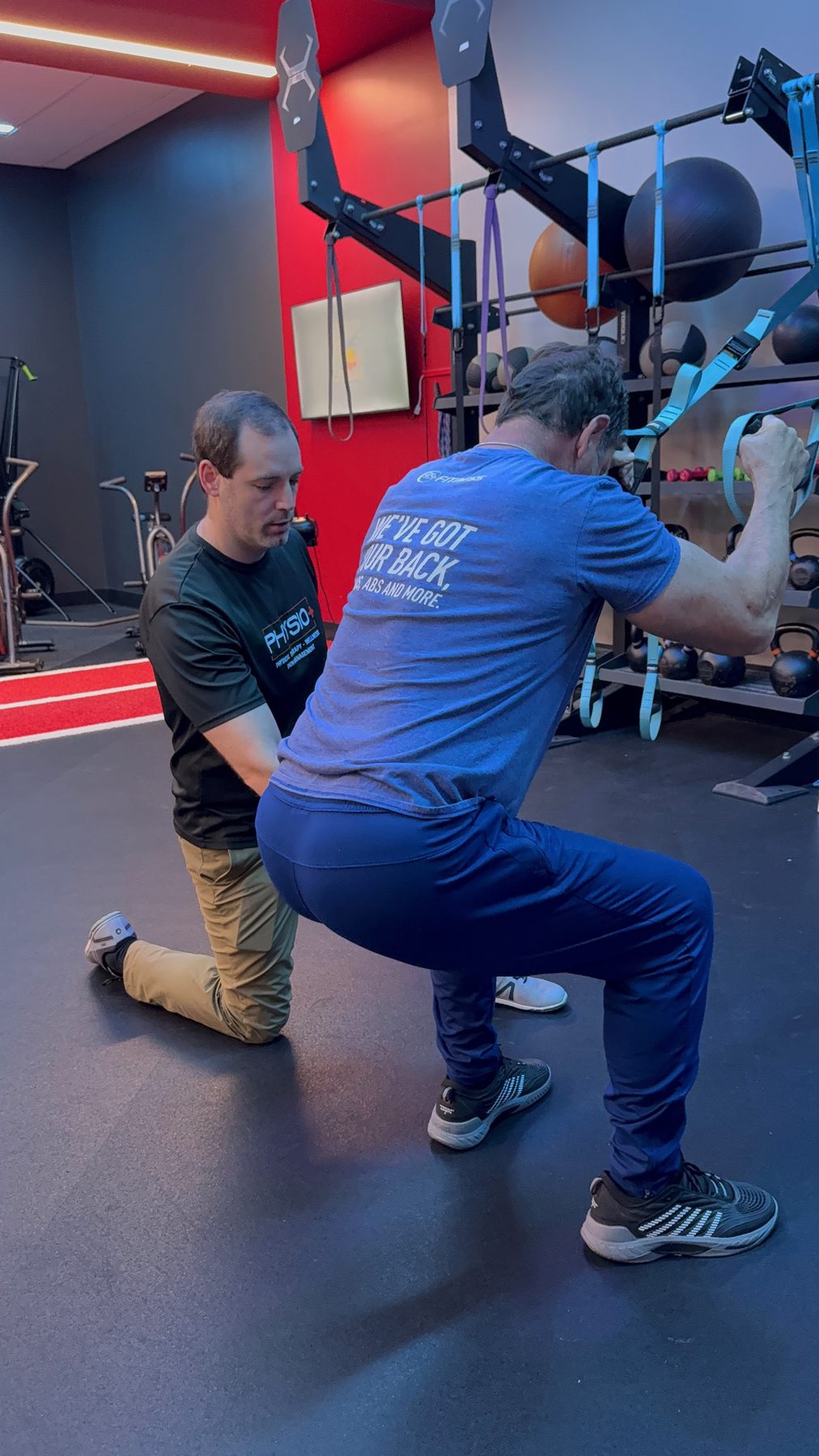
A Physio+ knee evaluation runs 60 minutes with a doctor of physical therapy. We test quad and hip strength side to side, screen the ligaments and meniscus, watch you walk, squat, and step down, and measure exactly where your capacity sits against what your life demands. You leave visit one with a pattern diagnosis, your first 2 to 3 exercises, and a timeline you can hold us to.
One of 7 patterns, in most cases. Read the descriptions below and you will likely recognize yours. The name matters less than the loading behavior: what provokes the pain, what calms it, and how fast it settles afterward. That behavior is what a doctor of physical therapy diagnoses and treats.
An ache at the front of the knee with stairs, squatting, and long sits, and the single most common knee diagnosis we make. Imaging is usually normal because the problem is load, not damage. The 2019 clinical practice guideline is clear: quad and hip strengthening together beats either alone, and rest earns no recommendation. Runners get the full deep dive, including cadence work, on our running injuries page.
Twisting injuries in younger knees, gradual degenerative fraying in knees past 40. The tell is pain with deep squatting or pivoting, sometimes with catching. Here is what the surgeon may not lead with: randomized trials found exercise therapy matched arthroscopic surgery for degenerative tears at 2 years. Most meniscus pain settles with 8 to 12 weeks of loading work. Our guide to conservative meniscus treatment walks through the whole decision.
Morning stiffness that loosens with movement, aching after activity, and the phrase bone on bone ringing in your ears. Exercise is the most consistently supported treatment for knee arthritis, and it does not wear the joint out faster: it is how many patients postpone or avoid replacement. The full arthritis playbook lives on our chronic pain and arthritis page and in our guide to managing knee arthritis without surgery.
Pinpoint pain at the bottom edge of the kneecap, worst with jumping, kneeling, and the first minutes of activity, in athletes and lifters who load hard. This is a tendon capacity problem and it answers to progressive heavy loading, not rest. For tendons still stubborn after 12 weeks of good loading, we add shockwave therapy alongside the program.
Sharp pain on the outside of the knee that shows up at a predictable point in a run or ride. The band itself is not tight in any way you can stretch: the driver is almost always hip and glute weakness letting the thigh collapse inward, which is why the foam roller never cured it. The full story, and the hip strength fix, lives on our running injuries page.
A plant, a pop, and swelling within hours: that story points at ligament. MCL sprains usually heal without surgery under a progressive plan. ACL decisions are bigger and depend on your sport, age, and instability, and we run both prehab and full return to sport testing for athletes on either path. Sport specific detail lives on our sports injuries page.
A ball of swelling and tightness behind the knee, often first noticed squatting or going down stairs. The cyst is almost never the disease: it is the knee's drainage response to something inside the joint, usually meniscus irritation or arthritis. Treat the driver and the cyst typically shrinks on its own. Drainage is reserved for the few that stay large and limiting.
Usually not. A skilled clinical exam identifies most knee patterns, and the first 4 to 6 weeks of treatment rarely change based on a scan. MRI earns its cost when red flags appear, when a locked knee will not straighten, or when 6 weeks of well run rehab moves nothing.
The reason we do not scan first is the imaging paradox. A 2019 meta-analysis of pain free, uninjured adult knees found cartilage defects in roughly 1 in 4 and meniscal tears in roughly 1 in 10, with both rising steeply with age. Scan enough healthy knees and you will find something in most of them. Treat the report instead of the person and you end up rehabbing, or operating on, a finding that was never the pain.
This is also why you do not need to wait on a physician visit to get started. Under Texas direct access law, a doctor of physical therapy can evaluate and treat you for up to 30 days without a referral. If your exam raises anything that genuinely needs imaging or a surgical opinion, we refer you the same week, with the exam findings already documented for the physician.
Because those movements concentrate force on the front of the knee. Deep bending under bodyweight multiplies load through the kneecap joint and patellar tendon several times over. When the quad and hip cannot share that work, the joint and tendon absorb the difference, and they are the tissues that complain first.
Which movement hurts is diagnostic information. Pain going down stairs more than up is classic kneecap joint behavior, because descending is braking work for the quad. Pain at the very bottom of the kneecap when you jump, land, or kneel points at the patellar tendon, especially with morning stiffness the day after training. A knee that complains at the bottom of a deep squat, or with a twist to get out of the truck, points toward meniscus. An ache that builds through a long sit, the movie sign, points back to the kneecap joint.
None of these patterns mean stop moving. They mean change the dose: shallower range, slower tempo, lighter load, then rebuild toward full depth as capacity returns. Around the loading plan we use manual therapy to restore joint and soft tissue motion, and dry needling when quad and calf trigger points are feeding the pain pattern. Both are support acts. Loading is the show.
Rarely, but the exceptions matter. A knee that swells within 2 hours of an injury, locks and will not fully straighten, gives way repeatedly, or turns hot and red with a fever needs medical assessment now, not a wait and see plan. So does an inability to bear weight after a fall.
Each of those signs points somewhere specific. Rapid swelling after injury usually means blood in the joint, which raises the question of ACL rupture or fracture. A knee stuck short of full straightening suggests a displaced meniscus fragment blocking the joint. A hot, swollen knee with fever or chills raises infection, which is a same day medical problem, not a rehab problem. Night pain that never varies with position deserves a physician workup too.
We screen every knee for this list at the first visit. When something flags, we refer the same week, usually with a direct call to the orthopedic group rather than a note in your pocket. Catching the rare serious knee early is part of the job. So is telling the other 9 out of 10 knees, honestly, that nothing on this list applies to them.
Week 1 is measurement and pain settling. Weeks 2 to 6 are progressive loading, 2 sessions a week with clear strength targets. Weeks 6 to 12 rebuild the specific capacity your life demands: stairs, squats, yard work, sport. You know your numbers at every step, and you know what next week holds.
Weeks 1 and 2 start with the 60 minute evaluation: strength benchmarks side to side, movement screening, and a working diagnosis. Early sessions lean on manual therapy and load modification to calm the knee enough to train, because a knee that hurts at 8 of 10 cannot practice anything. You leave with 2 to 3 exercises, not a 14 exercise sheet destined for the refrigerator door.
Weeks 3 to 6 move to the gym floor, at Fusion in Lindale or inside FIT Tyler at 2259 Broussard Street. This is where knee rehab actually happens: split squats, step downs, sled work, tempo squats, loaded to the point where the last reps are honest work. We retest your strength numbers every 2 weeks, so progress is a measurement, not a feeling.
Weeks 6 to 12 are about your specific finish line. For an athlete that means jump landings, cutting, and return to sport testing before Friday night. For a 60 year old it might mean a full flight of stairs without the handrail, an hour in the garden, or hunting season with a climb into the stand that the knee does not veto. The plan ends at your life, not at pain free rest.
On visit count, we will be straight with you: a typical knee runs 8 to 12 visits across those 12 weeks, front loaded early, spaced out as your home program takes over. We do not schedule 3 visits a week to fill a calendar. If your knee needs fewer, you get fewer.
One on one DPT care with a knee mechanics focus, not a generic sheet of exercises.
Explore Tendon workFor stubborn patellar or quad tendinopathy that has not responded to three months of loading.
Explore MeasurementSquat, gait, and landing mechanics measured, so the plan targets your actual loading problem.
Explore
Knees get stronger with load, not rest. We stage the squat, the step, and the run so cartilage, tendon, and quad all catch up.
Possibly torn, probably not surgical. Meniscus findings appear in roughly 1 in 10 pain free adult knees, and randomized trials show exercise therapy matches arthroscopy for degenerative tears. Surgery earns its place for true locking or failed conservative care. Our meniscus guide covers the decision in depth.
Almost always. We modify depth, load, and tempo rather than stopping training. Pain up to 3 of 10 that settles within 24 hours is generally acceptable to train through. Total rest weakens the exact muscles the knee needs, which is why rest so often backfires.
Most knees we see do not, or not yet. Exercise therapy improves pain and function in knee arthritis and helps many patients postpone or avoid replacement entirely. When replacement is the right call, we partner with your surgeon and run the rehab from day one.
Painless popping is normal joint noise from gas and tendon movement, and it does not predict damage or future arthritis. Popping that arrives with pain, swelling, catching, or giving way is different: that pattern deserves an evaluation. The sound alone is not the problem.
For stubborn cases, yes. When a patellar tendon has resisted 12 weeks of progressive loading, we add shockwave alongside the loading program rather than instead of it. Loading remains the treatment that rebuilds the tendon. Shockwave helps stubborn tendons start responding to it.
Most patients rebuild pain free depth inside 4 to 8 weeks using modified load and tempo, because squatting is a skill we restore progressively rather than avoid. Post surgical knees follow the protocol timeline instead, which we set together with your surgeon.
Usually only short term. A simple sleeve can improve comfort and confidence, and unloader braces help select arthritic knees. No brace strengthens anything, so we treat bracing as a bridge while strength work does the real job, never as the plan itself.
No. Texas direct access law (HB 4099, effective September 2025) allows up to 30 days of physical therapy care without a physician referral. Book the initial evaluation directly. If your exam suggests a fracture, infection, or anything needing imaging, we refer you the same week.
Book the initial evaluation. You leave with a working diagnosis, two to three exercises, and a clear timeline.