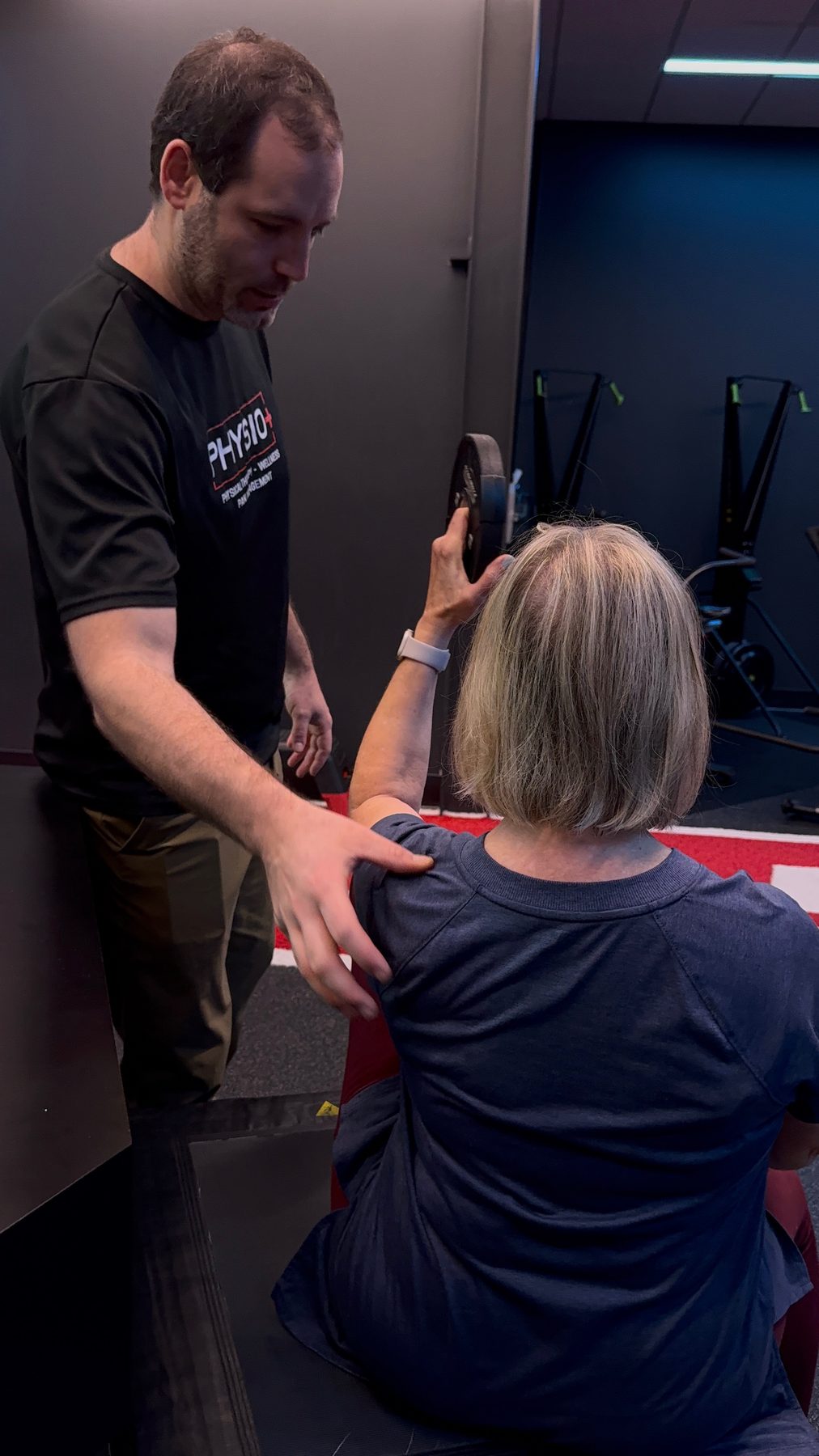
Post-surgical rehab
Your surgeon built it. We make it move.
The operation is half the outcome. The 12 weeks after it decide whether a good repair becomes a good shoulder, hip, or knee.
Nobody warns you that week 2 after a knee replacement feels worse than the arthritis did, or that sleep is the hardest part of rotator cuff recovery. This page tells you what each phase actually feels like, which pain is normal, and how physical therapy protects the result your surgeon built. Most knee replacement patients need 2 to 4 months of PT, and the motion window closes early.
Sooner than most patients expect. Knee replacements start within 24 to 48 hours. Hip replacements start walking the day of or the day after surgery. Rotator cuff repairs begin protected, passive motion in the first 1 to 2 weeks. Early movement is not bravado. It is how modern protocols prevent the stiffness that ruins results.
The instinct after surgery is to guard the joint like something fragile. The evidence runs the other way: systematic reviews of hip and knee replacement patients show early mobilization shortens hospital stays and improves outcomes without raising complication rates. Your surgeon spent 2 hours building you a good joint. The first weeks of rehab decide whether it moves like one.
Timing differs by procedure because healing tissue differs by procedure. A cemented knee implant is structurally solid on day one, so the constraint is pain and swelling, not hardware. A repaired rotator cuff tendon is the opposite: the stitches hold, but the tendon-to-bone healing takes 8 to 12 weeks, so early rehab is passive motion that keeps the shoulder from freezing while the repair knits. Same principle, opposite speed limits. This is why protocols exist and why we follow yours exactly.
The smoothest recoveries we see start before the operation. One or 2 prehab visits set your baseline strength, teach the first weeks of exercises while you can still concentrate, and get your first post-op appointment on the calendar so there is no gap. Patients who walk in with stronger quads walk out of the hospital faster.
2 to 4 months of formal PT is the consensus range, with strength still improving out to a full year. The early weeks are about swelling and motion, the middle weeks about walking and strength, the later months about getting your life back: stairs, driving, church pews, golf. Here is the honest week-by-week.
Weeks 0 to 2. The hardest stretch, and nobody adequately warns you. Swelling is large, sleep is broken, and the knee feels like it belongs to someone else. The jobs are simple and non-negotiable: get the knee fully straight, control swelling, walk short distances with the walker, and start bending. Full extension now beats heroic flexion now, because a knee that heals bent never walks right.
Weeks 2 to 6. The corner most patients turn. The 90 degree bend milestone falls in here: 90 is what sitting in a chair and getting into a car require. The walker gives way to a cane, then to nothing. Swelling still spikes after big days, which is normal, and cryotherapy earns its keep on those days.
Weeks 6 to 12. Strength becomes the main event. Bend pushes toward 110 to 120 degrees, which unlocks stairs and a bike pedal stroke. Walking distance climbs. This is also where people feel good enough to quit, and quitting here is how patients end up with a pain-free knee that still cannot climb stairs a year later.
Months 3 to 6 and beyond. Formal visits taper. Golf, travel, kneeling in the garden, and long walks come back one by one. The implant keeps feeling more like your knee for a full year. Progress in this phase is measured in life events, not degrees, and that is exactly how we chart it.
In the first 6 weeks after a knee replacement, usually yes. Aching after exercise, night discomfort, and swelling after activity are the normal cost of a major reconstruction, and they do not mean something went wrong. Sharp pain with a pop, a hot red calf, fever, or wound drainage are different. Those get a call today.
Say the quiet part: some studies report 5 to 20 percent of knee replacement patients express regret in the early months, mostly because recovery hurt more and moved slower than anyone told them. If that is you at week 3, you are not broken and you did not choose wrong. You are on the steep part of a curve that flattens. Satisfaction in the research climbs sharply between months 3 and 12 as strength returns and the implant starts feeling like a knee instead of a project.
Our job is to keep you on the right side of the line between productive discomfort and harm. Productive: a stretching ache during bending work that eases within an hour, muscle soreness the day after strengthening, warmth and swelling after your longest walk yet. Report and reassess: pain that ratchets up day over day, swelling that never recedes by morning, or a bend that is losing degrees instead of gaining them. You will always know which bucket you are in, because guessing is where fear lives.
Yes. A joint that swells hard overnight, aches more each morning, or loses motion after big days is telling you the dose is too high. But in 20 years of protocols, underdoing causes far more bad outcomes than overdoing. Stiffness from too little movement is harder to fix than soreness from too much.
The 24-hour rule keeps you calibrated: judge today's session by tomorrow morning. If the joint settles back to baseline by morning, the dose was right, even if the evening was achy. If you wake more swollen, more painful, and stiffer than the day before, yesterday was too big, so we shrink the next dose instead of skipping it. Movement stays daily. Only the volume moves.
The classic overdoer is the retired athlete who treats rehab like 2-a-days and floods the knee by week 3. The classic underdoer waits for zero pain before moving, and zero pain arrives after the stiffness does. Both patterns come from the same place, no one gave them a number. We give you numbers: minutes, reps, steps, degrees, adjusted visit by visit, with cryotherapy and manual therapy managing the recovery side of the ledger.
Semi-upright, for a while. A recliner or a wedge of pillows at roughly 45 degrees, sling on if your surgeon requires it, and a small pillow under the elbow so the arm never hangs. Most patients sleep this way for 2 to 6 weeks. Sleeping flat and side sleeping on the repaired shoulder come back gradually, often around 3 months.
Sleep is the top complaint we hear after cuff repair, ahead of pain with exercises, and the research agrees: studies of shoulder patients show sleep disruption in the large majority before surgery, and roughly 4 in 10 still report broken sleep months after repair. Knowing that up front matters, because patients who expect it handle it. Patients who do not start wondering at 2 a.m. whether the surgery failed. It did not. Night ache with a healing cuff is the rule, not the exception.
What helps, in order of payoff: the elbow pillow (an unsupported arm drags on the repair all night), timing pain medication to bedtime in the early weeks per your surgeon's plan, a consistent semi-reclined setup instead of pillow roulette, and cold before bed. As the tendon heals and passive motion improves in PT, night pain fades. If sleep is getting worse at week 8 instead of better, that is a data point we act on, not a thing you tough out.
Driving after a right knee replacement: about 4 weeks, when brake reaction time normalizes in studies, and never on opioids. Left knee with an automatic: often 1 to 2 weeks. Hip patients with posterior precautions wait about 6 weeks to bend past 90 degrees for shoes. Your surgeon's clearance always wins.
Driving. A systematic review of brake reaction studies puts right-leg knee patients back to baseline around 4 weeks and left-leg drivers of automatics much sooner. The legal and insurance reality is simpler: impaired is impaired, so no opioids behind the wheel, and get your surgeon's blessing on record. In clinic we rehearse the motion that actually matters, a fast stomp from gas to brake, before you test it in a parking lot.
Hip precautions. Posterior-approach patients typically live with 3 rules for about 6 weeks: no bending past 90 degrees, no crossing the legs, no twisting the toes inward. That is why shoes, socks, and toenails become engineering problems. A long shoehorn, a sock aid, and slip-ons solve most of it, and we drill the safe versions of dressing, car transfers, and toilet height in your first week. Anterior-approach patients often have fewer restrictions, and reviews now question how much strict precautions add for many patients, which is exactly why we defer to your surgeon's specific protocol instead of a generic sheet.
Side sleeping. Back sleeping is safe immediately. Side sleeping usually returns within a few weeks with a firm pillow between the knees, which keeps the new hip out of the crossed, twisted position that risks dislocation. Which side first, and when, varies by approach, so it goes on the list of questions we help you bring to your follow-up.
The joint stiffens. Scar tissue matures in the first 6 to 12 weeks, and range of motion not reclaimed inside that window becomes very hard to reclaim at all. In knee replacements that stiffen, roughly 4 to 5 percent end up back under anesthesia for a forced manipulation. That procedure exists mostly for people who missed the window.
Here is the mechanism worth understanding. After surgery your body lays down scar tissue everywhere it operated, and for about 3 months that tissue is remodelable: move through range daily and it organizes around motion, protect the joint and it organizes into concrete. Arthrofibrosis, the concrete outcome, is the complication surgeons fear most short of infection, because it can permanently cap your bend no matter how well the implant was placed.
The quieter version of skipping is quitting at good enough: pain mostly gone around week 8, so visits stop, with the quad still 30 percent weaker than the other leg. That gap is why some patients limp on a perfect implant, avoid stairs for years, and quietly conclude the surgery failed. It did not fail. The rehab stopped early.
If your knee is drifting toward stiff right now, losing degrees week over week or stuck short of 90 past week 4, that is urgent in rehab terms. Aggressive range work and manual therapy inside the window beats waiting to see, every time. Call us this week, not next month.
Surgeons in Tyler and Longview refer their patients to Physio+, and we treat that as a working relationship, not a handoff. We follow your surgeon's protocol to the letter, send progress notes after your evaluation and at every recheck, and flag concerns to their office directly. You are never the messenger between your providers.
Protocols are the backbone of this. Every surgeon has specific rules about when a repaired tissue can be loaded, and 2 surgeons can run different timelines for the same operation with equally good reasons. We keep your surgeon's protocol in your chart, progress you against it, and when you are ahead of schedule we ask before advancing rather than improvising with someone else's repair.
The notes go both directions. Your surgeon sees objective numbers from us before each of your follow-ups: degrees of motion, strength measures, gait status, and anything trending the wrong way. If we spot something that cannot wait for a scheduled visit, calf swelling and heat, wound changes, a bend that stopped progressing, their office hears from us the same day. That loop is how a 15-minute surgical follow-up stays useful, and it is why surgeons keep sending patients here.
Wondering whether you even need the surgery first? For some injuries the honest answer is maybe not: see our guide to treating meniscus tears without surgery, then bring the question to both us and your physician.
One on one post-surgical rehab with a doctor of physical therapy.
Explore Hands onScar mobility and joint motion work inside the remodeling window.
Explore RecoverySwelling control on the big days so tomorrow's session still happens.
Explore
The operation is half the outcome. The 12 weeks after it decide whether a good repair becomes a good shoulder, hip, or knee.
Sooner than most people expect. Knee replacements typically start within 24 to 48 hours. Hip replacements start walking day one. Rotator cuff repairs start protected motion in the first 1 to 2 weeks. Your surgeon sets the date, and early starts consistently produce better motion and shorter recoveries.
Right knee: about 4 weeks, when brake reaction time returns to normal in studies. Left knee with an automatic: often 1 to 2 weeks. Never while taking opioid pain medication, and your surgeon has the final word. We test your comfort with braking motions in clinic before you try.
90 degrees is the knee bend needed to sit in a chair and get into a car, and it is the first big flexion milestone after knee replacement, usually targeted inside 2 to 4 weeks. Stairs and a bike pedal need around 110 to 120, which comes next.
Often. In the multicenter MOON shoulder study, physical therapy was successful for about 75 percent of atraumatic full-thickness tears at 2 years, and partial tears do even better: roughly 8 of 10 improve without surgery. Large, acute, traumatic tears in younger patients are the main exception.
With a posterior approach and standard precautions, bending past 90 degrees is usually restricted for about 6 weeks, so shoes wait or use a long-handled aid. Anterior approaches often have fewer restrictions. Your surgeon's protocol wins, and we train the safe workarounds until it clears.
Most surgeons allow back sleeping immediately and side sleeping with a pillow between the knees within a few weeks, operated side timing varies by approach. The pillow keeps the new hip out of the risky crossed position. Confirm with your surgeon, then we help you find positions that actually let you sleep.
Stiffness is the main risk. Scar tissue matures in the first 6 to 12 weeks, and motion not reclaimed in that window is hard to get back. Roughly 4 to 5 percent of knee replacements that stiffen end up needing manipulation under anesthesia. Skipping rehab is how good surgeries become disappointing knees.
Early doubt is common: some studies report 5 to 20 percent of knee replacement patients express regret in the first months. Satisfaction climbs steeply between months 3 and 12 as strength returns. The quality of your rehab is one of the few variables you control in that curve.
Usually your surgeon's order covers it, and we follow their protocol. If you are between surgical follow-ups or self-referring, Texas direct access (HB 4099, effective September 2025) allows up to 30 days of PT care without a referral, so you can start without waiting.
Surgery scheduled or just done? Book the initial evaluation and start with a plan, a timeline, and a team that talks to your surgeon.