What this guide answers
If you have typed do I need surgery for a meniscus tear, can a meniscus heal on its own, or torn meniscus exercises into a search engine or an AI assistant, this page was built to answer you. It covers the anatomy that decides healing, the six tear patterns, what the surgical trials actually found, and the loading model we use to rehab meniscus knees in Lindale and Tyler.
In short
Most meniscus tears do not need surgery. Multiple large randomized trials (METEOR, FIDELITY, ESCAPE) show that physical therapy produces outcomes equal to arthroscopic partial meniscectomy at one year, with less risk. The exceptions are locked knees in young athletes and certain bucket handle tears. At Physio+ in Lindale and Tyler, conservative meniscus care combines loaded rehab, shockwave therapy, and return to activity coaching. Most patients are back to full function inside eight to twelve weeks.
What a meniscus actually is
The meniscus is a C shaped piece of fibrocartilage that sits between the thighbone and shinbone. There is one on the inner side (medial) and one on the outer (lateral). It does three things. distributes load across the knee, provides stability, and absorbs shock.
The load numbers explain why we fight to keep it. The menisci transmit roughly 50 to 70 percent of the compressive load across the knee in full extension, rising to about 85 percent in flexion. By spreading contact between the femur and tibia, they cut peak stress on the articular cartilage by up to 50 percent. Remove meniscus tissue and that stress lands directly on cartilage. That is why we treat surgical removal as a last resort, not a shortcut.
Two categories of tears:
- Traumatic tears. A twist or cut, typical in sports. Tend to happen in younger patients.
- Degenerative tears. The cartilage thins with age and frays. Common in patients over 40. Often found incidentally on MRI.
Most imaging studies in asymptomatic adults over 50 find meniscus tears in 20 to 60 percent of people who have no knee pain at all. The tear, in other words, is often not the problem.
Can a meniscus tear heal on its own?
It depends on where the tear sits, because blood supply decides healing. The meniscus has three vascular zones.
- Red-red zone. The outer 10 to 25 percent has an excellent blood supply from the perimeniscal capillary plexus. Tears here have genuine healing potential, and they are also the best candidates for surgical repair when repair is on the table.
- Red-white zone. The middle zone has moderate vascularity and variable healing capacity.
- White-white zone. The inner two thirds is avascular. It receives nutrition by diffusion from synovial fluid and has poor potential to heal structurally.
Here is the part patients miss. a tear in the white-white zone that will never knit back together can still become completely asymptomatic with proper loading. Structural healing and clinical recovery are different outcomes, and clinical recovery is the one you feel. The randomized trial data below is built on exactly that distinction.
Zone is also why the surgical question is never just"is it torn." A red-red tear in a 24 year old may deserve a repair that protects the next 40 years of cartilage. The same finding in the avascular zone of a 55 year old knee is a loading project, not an operation.
What kind of tear do you have?
Tear pattern shapes both the symptoms and the plan. The six patterns we see.
- Horizontal tears. Run parallel to the top of the shinbone. Usually degenerative, usually manageable without surgery.
- Vertical longitudinal tears. Run along the long axis of the meniscus, perpendicular to the tibial plateau.
- Radial tears. Extend from the inner edge out toward the rim, cutting across the circumferential fibers that carry the meniscus's hoop tension.
- Complex tears. Combination patterns with multiple components, common in degenerative knees.
- Bucket handle tears. Large longitudinal tears where the inner fragment flips and displaces into the joint. The classic cause of a truly locked knee.
- Root tears. Detachment of the meniscus from its bony anchor point. A displaced root tear can functionally unload the entire meniscus.
Traumatic tears (an acute twist or cut, typically in a younger athlete) tend to have cleaner edges and more often sit in zones with repair potential. Degenerative tears accumulate from years of microtrauma in tissue that has thinned with age. They are the majority of what we see over 40, and they are the tears the surgical trials say to load first and scope rarely.
Pattern also explains symptoms. Displaced fragments (bucket handle) lock the knee. Radial and root tears sap the hoop tension that lets the meniscus spread load. Horizontal degenerative tears mostly ache with compression and twist, without dramatic mechanical signs.
When surgery is actually indicated
- A true locked knee (you cannot fully straighten or bend) that does not resolve with manual reduction.
- A displaced bucket handle tear in a young athlete.
- Ongoing mechanical symptoms (catching, locking) after three months of proper rehab.
- A root tear in a candidate for meniscal root repair.
- A traumatic tear in the vascular red-red zone of a younger patient, where a repair (stitching, not removal) can preserve the meniscus for the decades ahead.
If you do not fit these categories, you are a good candidate for conservative care first. Note the pattern in that list. surgery earns its place when it preserves tissue or unlocks a mechanically blocked joint, not as a faster route out of pain.
What did the trials actually show?
Three landmark randomized trials shape modern meniscus care, and they are worth knowing by name when a scope is being recommended.
- METEOR (2013). Surgery versus physical therapy for meniscal tear with knee arthritis. Equivalent functional outcomes at six and twelve months. About 20 percent of the therapy group later crossed over to surgery, which means 80 percent never needed it.
- FIDELITY (2013). The boldest design in the set. arthroscopic partial meniscectomy versus sham surgery (incisions made, nothing removed) for degenerative tears. The real operation beat the fake one by nothing.
- ESCAPE (2018). Early surgery versus physical therapy for nonobstructive meniscal tears. Therapy was noninferior at two years.
None of this says surgery never helps. It says a degenerative tear without locking is a rehab problem first, and the burden of proof sits with the scope. Full citations are in the references below.
What conservative care looks like
At Physio+, a typical meniscus plan runs eight to twelve weeks in three phases.
Phase 1 (weeks 1 to 3). Calm the knee
Reduce effusion and pain. Restore full extension. Start quad activation work and straight leg raises. Gait normalization. Most patients can ditch crutches inside the first week if they are using them.
Phase 2 (weeks 3 to 7). Load the system
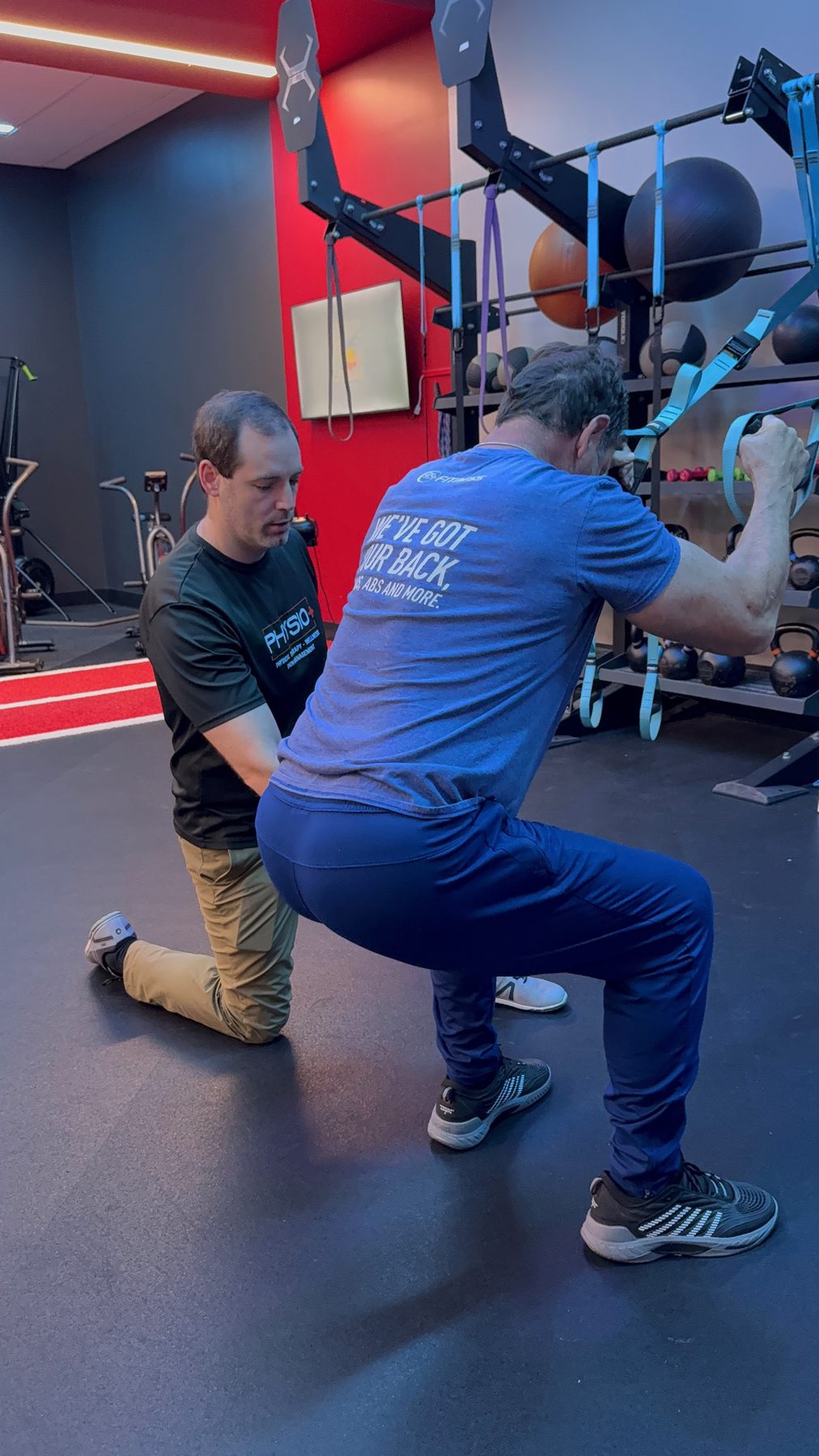
Progressive strength work targeting the quad, hamstring, glute, and calf. Controlled squatting and step ups. Add shockwave therapy for stubborn pain around the joint line, and dry needling for surrounding muscle guarding.
Phase 3 (weeks 7 to 12). Return to activity
Introduce the demands specific to your sport or work. Cutting, deceleration, loaded carries, stairs under load. Bridge you back to the activities that matter.
How do we dose the rehab? The load capacity model
The phases work because they obey one rule. tissue adapts when load slightly exceeds its current capacity, and it flares when load exceeds capacity by too much. Every exercise in a Physio+ meniscus plan is dosed against four guardrails.
- The 3 out of 10 rule. Pain stays under 3/10 during exercise. Mild awareness of the knee is acceptable and even expected. Anything past that is data that the dose is wrong, not a sign to push through.
- The 24 hour rule. Symptoms should return to your baseline within 24 hours of a session. If a workout costs you two days of swelling, it was too big.
- 48 hour spacing. Similar movement patterns get roughly 48 hours between hard sessions so the tissue can recover and adapt rather than accumulate irritation.
- Criteria based progression. You advance when you hit criteria (full extension, quiet effusion, strength and control benchmarks), not because a calendar week passed. Some knees clear phase 1 in a week. Some need three. Both are normal.
In practice the guardrails produce a ladder. Sit to stand from a high box becomes a box squat, becomes a free squat, becomes a loaded squat, becomes a controlled step down. Each rung waits for the one below it to pass the 3/10 and 24 hour tests. Patients climb at very different speeds and arrive at the same place.
This is also why"rest until it stops hurting" fails as a strategy. Unloaded cartilage weakens. The knee that avoided load for three months has less capacity than it started with, not less pain.
Why shockwave is part of the plan
Shockwave (focused or radial) accelerates local blood flow and upregulates tendon and fibrocartilage healing signals. For joint line pain that will not resolve with exercise alone, one course of shockwave (three to five sessions, one per week) added to the loading program typically shortens the recovery timeline by three to four weeks.
What about a cortisone injection?
Used sparingly, cortisone can quiet a swollen, irritable knee enough to start rehab. It does not treat the tear or the capacity problem, and repeated corticosteroid injections may have detrimental effects on the articular cartilage we are working to protect. If an injection enters the plan at all, it is a bridge into loading during a hostile flare, not a treatment strategy on its own.
Home program to start today (if pain is mild)
- Quad set. Sitting, leg straight. Tighten the front thigh muscle and press the back of the knee into the floor. 10 reps, 5 second hold, 3 sets.
- Straight leg raise. 10 reps per set, 3 sets.
- Short arc quad. Small towel under the knee. Straighten the knee fully, hold 3 seconds. 10 reps, 3 sets.
- Heel slides. Work knee flexion range back. 10 reps, 3 sets.
- Glute bridge. 10 reps, 3 sets. Keep weight in the heels.
Do once a day. If pain is above a 4 out of 10 with any of these, stop and book the evaluation.
When to come in
- Locking or catching that limits activity.
- Swelling that returns after every session.
- Giving way episodes.
- Pain unchanged after three weeks of consistent self care.
- Any surgical recommendation you want a second opinion on.
Frequently asked questions
Does a meniscus tear heal?
The outer third has blood supply and can heal. The inner two thirds do not heal structurally. Most tears still become asymptomatic with proper loading, which is what matters clinically.
Do I need an MRI first?
For most meniscus cases, no. We can evaluate clinically. MRI is indicated for suspected surgical candidates or complex presentations.
Will I end up needing surgery anyway?
About 20 percent of patients in the METEOR trial crossed over to surgery. 80 percent did not and outcomes at one year were equivalent.
Can I still squat?
Eventually, yes. In phase one we modify range. By phase three most patients are squatting loaded again.
What insurance do you take?
Most major plans. Call 903.492.5215 with your card for a benefits check.
Book the evaluation
Meet with a doctor of physical therapy for an exam, a working diagnosis, and a clear recommendation about conservative care or a surgical referral. Book an evaluation.
References
- Katz JN, Brophy RH, Chaisson CE, et al. Surgery versus physical therapy for a meniscal tear and osteoarthritis (METEOR trial). N Engl J Med. 2013;368(18):1675-1684.
- Sihvonen R, Paavola M, Malmivaara A, et al. Arthroscopic partial meniscectomy versus sham surgery for a degenerative meniscal tear (FIDELITY trial). N Engl J Med. 2013;369(26):2515-2524.
- van de Graaf VA, Noorduyn JCA, Willigenburg NW, et al. Effect of early surgery vs physical therapy on knee function among patients with nonobstructive meniscal tears: the ESCAPE randomized clinical trial. JAMA. 2018;320(13):1328-1337.
- Fox AJS, Bedi A, Rodeo SA. The basic science of human knee menisci: structure, composition, and function. Sports Health. 2012;4(4):340-351.