Sports injuries
Rehab that looks like training.
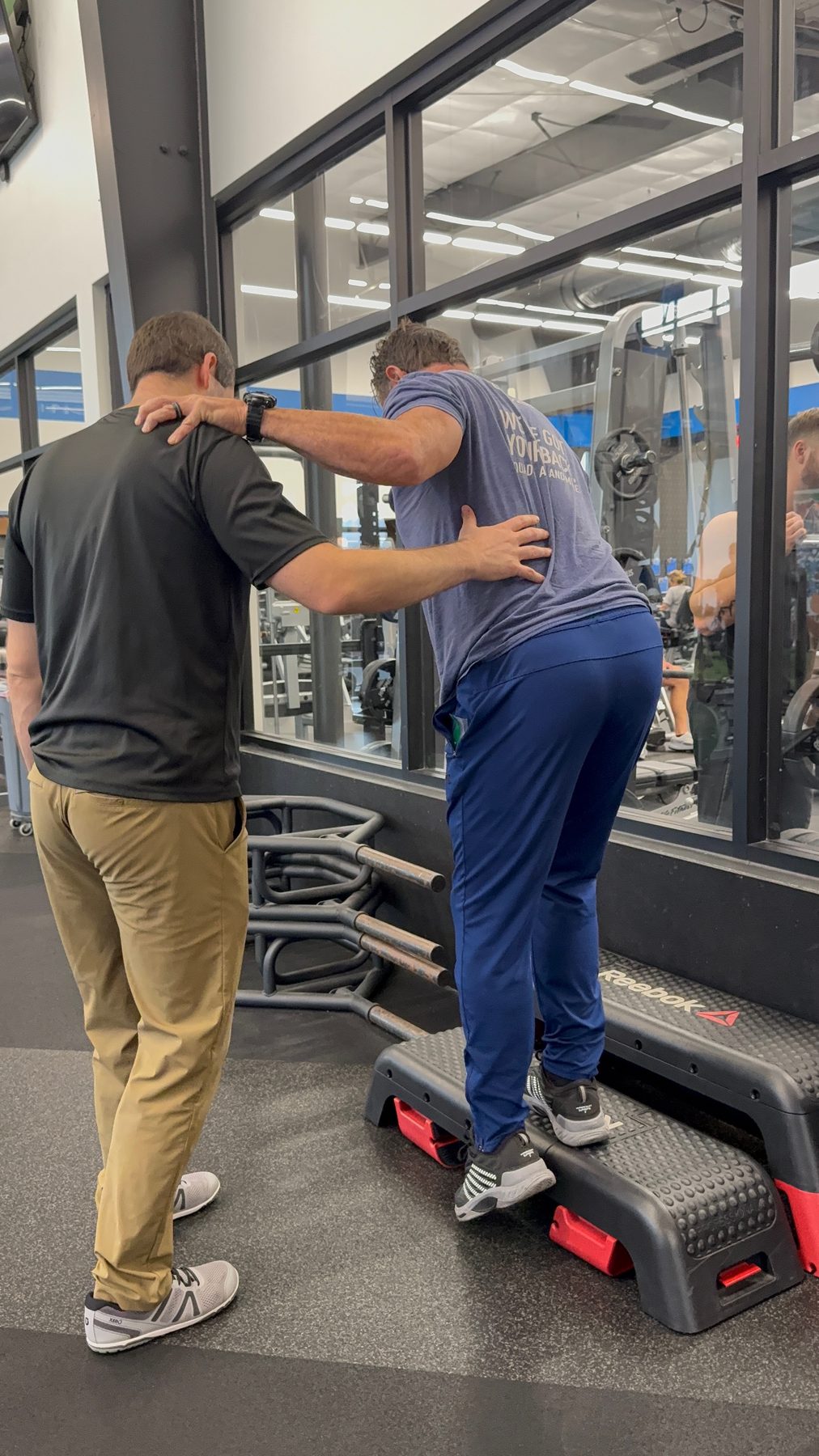
Late-phase rehab happens under a bar and on a field, not on a table. We rebuild the athlete past the level that failed, then prove it with tests before anyone says go.
"My knee doesn't feel the same. I don't trust it." We hear that sentence more than any other in sports rehab, and the research agrees: over half of athletes who never make it back to their sport cite fear of reinjury, not the tissue. This page covers real recovery timelines, when surgery actually matters, why hamstrings re-pull, and the tests that clear you by criteria instead of calendar.
It depends on the tissue, not the wish. Mild ankle sprains return in 1 to 3 weeks, grade 1 hamstring pulls in 2 to 3 weeks, grade 2 pulls in 4 to 8 weeks, and ACL reconstructions take 9 months or more for cutting sports. The honest answer is a test result, not a date on a calendar.
Before any timeline, the sentence that opened this page deserves a straight response."My knee doesn't feel the same, I don't trust it" is not weakness and it is not in your head. In studies of athletes who never returned to their sport, more than half named fear of reinjury as the reason, ahead of pain, swelling, or any physical finding. A good rehab plan treats the tendon and the trust, and we do both on purpose, starting visit one.
If your pain built up over weeks of mileage instead of one bad moment, that is an overuse problem with its own playbook: runner's knee, IT band, shin splints. Start with our running injuries pillar instead. This page covers the injuries that happen in a moment: the pull, the sprain, the tear, and the comeback after each.
Often, yes. Most sprains, strains, and even many complete tears do well without an operation. The famous exception cuts both ways: a torn ACL does not reliably heal itself, yet a landmark trial found half of patients who started with rehab never needed the surgery and did just as well at 2 and 5 years.
Start with the injury everyone fears most. In a randomized trial published in the New England Journal of Medicine, young active adults with fresh ACL tears were assigned either to early reconstruction or to structured rehab with surgery only if the knee proved unstable. About half of the rehab-first group never had the operation, and their outcomes matched the early-surgery group at 2 years and again at 5. Rehab first did not burn the surgical bridge; it just meant fewer people needed to cross it.
It gets more interesting. A 2023 reanalysis of that trial's MRIs found just over half of the ACLs managed with rehab alone showed evidence of healing at 2 years, something the textbooks long said did not happen. None of this makes surgery wrong. An athlete headed back to cutting sports on a knee that keeps giving way is often better served by reconstruction, and we help arrange it and rehab it. It means the decision deserves an examined knee and your actual goals, not a reflex.
Outside the ACL, the odds tilt further toward rehab. Most hamstring, calf, and groin tears, most ankle sprains including many grade 3s, and most shoulder sprains recover fully without an operation when the rebuild is done properly. The surgeon should be a considered stop on some roads, not the default first one on every road.
Because most rehab stops at pain-free jogging, and most returns run on a calendar. About 1 in 3 hamstring pulls recur within a year, many in the first 2 weeks back, because the muscle was never rebuilt at the long lengths and sprint speeds that tore it in the first place.
The re-pull is so common it has a script. Week 1: rest until walking feels fine. Week 2: jog a little, feel nothing, declare victory. First full-speed sprint back at practice: grab the back of the leg again, usually a grade worse than the original. The frustration athletes bring us after the second pull is really a question: why did resting not work? Because rest was never the treatment. It was just the waiting room.
Hamstrings tear at full stretch under maximum load, in the split second before the foot strikes at sprint speed. Jogging never visits that zone, so rehab that ends at jogging never rebuilds it. The fix is eccentric strength work at long muscle lengths: Nordic curls, long-lever bridges, and single-leg deadlift patterns, progressed until the muscle is strongest in the exact position where it failed. Then sprinting itself gets rebuilt in measured exposures, 60 percent, 75 percent, 90 percent, before anyone says full go.
We see the calendar pressure behind the shortcut, too. When a Lindale High School or Tyler Legacy athlete pulls a hamstring in September, the math on getting back under the lights before the season ends is real. We treat that pressure with respect: an honest timeline in week 1, criteria the athlete and the coach can both read, and a sprint progression that gives the kid the best odds of finishing the season on the field instead of in street clothes.
Then you are normal, and you are not done. Fear of reinjury is the most commonly cited reason athletes never return to their sport, ahead of any physical finding. Confidence is trainable the same way a quad is: graded exposure to the exact movements you dread, measured, repeated, and progressed.
The clearance letter says the graft is solid. Your body has not signed it. Hesitating on the plant leg, cutting at 80 percent, bracing before every landing: these are not character flaws. They are a nervous system doing exactly what it learned to do on the day you got hurt, and no amount of being told you're fine retrains it.
The numbers put the problem on the map. A meta-analysis following athletes after ACL reconstruction found only 55 percent returned to competitive sport, and when researchers asked non-returners why, fear of reinjury topped the list. There is a validated questionnaire for exactly this, the ACL-RSI, and we use it the way we use a strength test: score it at baseline, train what it exposes, retest it before clearance.
Training it looks like graded exposure, not pep talks. We rebuild the exact movement you flinch from in steps: land from 6 inches, then 12, then off one leg, then cut at half speed against air, then against a bag, then against a defender. Each completed step is evidence, and your nervous system was watching the whole time. Confidence follows proof. We manufacture the proof.
With criteria, not a calendar. Before we clear you, the injured side has to test within 90 percent of the healthy side on strength and hop tests, sport-specific movement has to look clean under fatigue, and your confidence score has to say you believe it. Passing that battery cuts reinjury risk sharply.
The battery borrows from the Delaware-Oslo ACL cohort, where athletes who passed objective discharge criteria before returning cut their knee reinjury risk by 84 percent compared to those who returned without passing. The tests themselves are simple to name and hard to fake: quad strength within 90 percent of the uninjured side, measured with resistance, not eyeballed. Single hop, triple hop, crossover hop, and timed hop for distance and control, all within 90 percent symmetry. Movement quality screened late in a session, because form that survives the fourth quarter is the only form that counts.
The same logic runs for every sports injury we treat, not just the ACL. Hamstrings earn clearance through sprint testing at full speed, not through a pain-free jog. Ankles pass hop and balance batteries. Shoulders climb a throwing progression with counted reps at measured intensities. In every case the question is identical: does the tissue now tolerate more than the sport will ask of it?
Criteria protect you from the opposite mistake, too: being benched longer than necessary by a blanket rule. Some athletes pass at month 9, some need 12, and some ankle sprains clear in 10 days. The test decides, which means nobody is guessing with your season, in either direction.
The odds turn against you fast. In ACL research, every month return was delayed up to 9 months cut reinjury risk by 51 percent, and athletes who skipped the strength and hop criteria reinjured at several times the rate of those who passed. Going back early is a bet with bad math.
Here is what the bet looks like when it loses. A second ACL injury means another surgery, another 9 plus months, and statistically worse odds of ever returning to your previous level. In one professional cohort, athletes who returned without meeting all 6 discharge criteria ruptured their graft at 4 times the rate of athletes who met them. The re-tear does not just repeat the first injury's cost. It compounds it.
Hamstrings run the same racket at a smaller scale. The recurrence risk is highest in the first 2 weeks after return, and a re-pull is typically a grade worse than the original, which converts a 3 week absence into an 8 week one. One more week of loaded sprint work is the cheapest insurance in sports medicine.
If you are on the other side of this problem, not injured yet and wanting to stay that way, prevention has its own evidence base and its own page: read our library breakdown of ACL tear prevention for basketball athletes.
One 60 minute evaluation, then a written weekly plan with 3 phases: calm the injury while training everything else, rebuild strength past the level that failed, then reintroduce sprinting, cutting, and jumping under measurement. You keep lifting from week 1, and you always know which test unlocks the next phase.
Everything starts with the initial evaluation: 60 minutes with a doctor of physical therapy, a diagnosis, a phase map taped inside your training notebook, and your first exercises the same day. From there most athletes see us 1 to 2 times a week and carry a written program between visits. Phase 1 protects the injured tissue without letting the athlete detrain: a pulled hamstring does not excuse the bench press, and a sprained ankle does not cancel upper body work. Phase 2 rebuilds capacity past the level that failed, with numbers on the wall. Phase 3 reintroduces speed: sprinting, cutting, jumping, landing, all progressed against the criteria in section 05.
We run this inside real gyms, at 140 E Eagle Spirit Dr in Lindale and inside FIT Tyler at 2259 Broussard Street, which matters because late-phase rehab looks like training, not therapy. Friday night football sets the rhythm of our fall, and we plan September injuries against the playoff calendar. We also see what year-round youth sports do to young bodies: select baseball, club volleyball, and soccer schedules with no off-season. Parents, one honest marker: an athlete who needs 2 recovery days is not falling behind, they are absorbing the work.
The full program, including how we coordinate with coaches and athletic trainers, lives on our sports rehab service page. If you want the strength side after clearance, that is sport performance.
No. Texas direct access law (HB 4099, effective September 2025) allows up to 30 days of physical therapy care without a physician referral. An athlete can be on our schedule this week, evaluated, and started, while teammates are still waiting on an orthopedic appointment that averages 12 to 17 days out.
The 30 day window tripled the old 10 day limit, and it changed the math for in-season injuries. A grade 1 hamstring pull evaluated on Monday can complete its entire rehab arc inside the direct access window, no referral, no waiting room, no lost week. For an athlete whose season is 10 games long, the difference between starting rehab on day 2 and day 14 can be the season.
Direct access does not mean nobody else is ever involved. If your exam raises anything that needs a physician, an unstable joint, a suspected fracture, a mechanism that warrants imaging, we refer you the same week and coordinate the plan. If your athlete already has a team physician or athletic trainer, we work with them, not around them.
Booking takes 2 minutes at physioplustx.com/book, by phone at 903.492.5215, or by email at hello@physioplustx.com.
Criteria-based rehab from injury to return to play, in Lindale and Tyler.
Explore After clearanceThe strength and speed work that keeps the injury from repeating.
Explore NeuromuscularFor the guarded, knotted muscle that will not let rehab progress.
Explore
Late-phase rehab happens under a bar and on a field, not on a table. We rebuild the athlete past the level that failed, then prove it with tests before anyone says go.
A grade 1 pull usually takes 2 to 3 weeks before running feels normal, a grade 2 closer to 4 to 8. Healing and being ready to sprint are different finish lines, though. We clear hamstrings with strength and speed tests, because going back on feel alone is how they re-pull.
Sometimes. In a randomized trial, half the patients who started with rehab never needed reconstruction and did as well at 5 years, and follow-up MRIs showed just over half of rehab-only ACLs had signs of healing. It depends on your sport, your knee stability, and your goals. We help you decide with data.
For cutting and pivoting sports, the evidence says yes. Each month of delay up to 9 months cut reinjury risk by 51 percent in one cohort study. Nine months of drifting will not get you there, though. What protects you is 9 months of progressive work plus passing the return tests.
A strain is muscle or tendon, a sprain is ligament, and a tear is either one at higher grade. You cannot reliably tell from pain alone; a grade 1 tear can hurt more than a grade 2. A hands-on exam grades it in one visit, usually without imaging.
Completely normal, and worth taking seriously. Fear of reinjury is the most common reason athletes never make it back, cited by over half of those who quit. A short block of graded exposure work, cutting and landing drills built up step by step, usually rebuilds the trust the clearance letter could not.
You roll the dice on a second, worse injury. Athletes who returned without passing strength and hop criteria reinjured at several times the rate of those who passed, and a second ACL or hamstring injury usually costs more time than the first. One more month of work is cheaper than a second season.
No. Texas allows up to 30 days of physical therapy without a referral under HB 4099, effective September 2025. Book the initial evaluation directly and we start the same visit. If the exam shows anything that needs imaging or a physician, we refer you the same week and coordinate the plan.
Usually yes, in a modified role. Most injuries tolerate some training, and athletes who stay involved keep fitness, skill, and standing on the roster. We write the modification list for the coach: what is allowed this week, what is not yet, and which test moves them up.
Book the initial evaluation. You leave with a diagnosis, a phase map, and the exact tests that will clear you to play.