Balance
Board certified. Neuro trained.
Logan is a board certified neurologic clinical specialist. Vestibular testing, BPPV, and fall prevention programs built for East Texas seniors.
Most dizziness has a findable, fixable cause. The most common one, BPPV, resolves in 1 to 3 visits with a repositioning maneuver backed by Cochrane review evidence. Balance itself is trainable at every age: structured exercise cuts fall rates by about 23 percent. Care at Physio+ is led by Logan Merritt, a Board Certified Neurological Clinical Specialist, a credential held by under 3 percent of US physical therapists.
That pattern, brief spinning triggered by rolling over, lying down, or tipping the head back, is the classic signature of BPPV: loose crystals in the inner ear canals. It is the most common cause of vertigo, and a trained clinician can usually clear it in 1 to 3 visits with a repositioning maneuver.
The mechanics are almost mundane for something so terrifying. Your inner ear contains tiny calcium crystals that belong in one chamber. When a few drift into a semicircular canal, certain head positions set them rolling, and the canal reports a spin that is not happening. Your eyes disagree, your brain panics, and 20 seconds later it passes, until the next time you roll over. Nothing is damaged. Something is misplaced.
The evidence for treatment is unusually strong. A Cochrane review found the Epley maneuver clearly outperforms sham treatment for resolving the crystals and the vertigo. The catch is targeting: there are 3 canals on each side, and the maneuver only works when it matches the affected canal and side. That is why the YouTube version fails so often, and why we run positional testing before anyone gets repositioned. The clinic-level walkthrough of that testing lives on our vestibular therapy page.
Every balance and dizziness evaluation at Physio+ runs 60 minutes with Logan Merritt, PT, DPT, NCS, a Board Certified Neurological Clinical Specialist, a credential held by under 3 percent of US physical therapists. The exam covers oculomotor testing, positional testing for BPPV, a neurological screen, standardized balance measures, and a fall risk score. You leave knowing which system is driving the problem and what the plan is, and if the pattern points outside our lane, you leave with a referral instead of a guess.
Age changes the inputs, but decline is not a fixed schedule. About 1 in 4 adults 65 and older falls each year, yet a 2019 Cochrane review of 108 trials found structured balance and strength exercise cuts the rate of falls by about 23 percent. Balance responds to training the way muscle does, at every age.
Balance runs on 3 inputs: vision, the inner ear, and the position sensors in your feet and joints. All 3 fade quietly with age, and the system compensates so smoothly you rarely notice until it is overdrawn: a curb in a dark parking lot, a wet porch step, the dog underfoot. The first fall is usually not the first problem. It is the first time the compensation ran out.
What we watch for hardest is the shrinking world. After a fall, or even a close call, people quietly retire things: the garden goes first, then the church pews that require a long walk, then night driving, then the trip to Tyler. Each retirement feels prudent, and each one removes exactly the practice that keeps balance alive. Fear of falling predicts future falls in its own right, and it is trainable too.
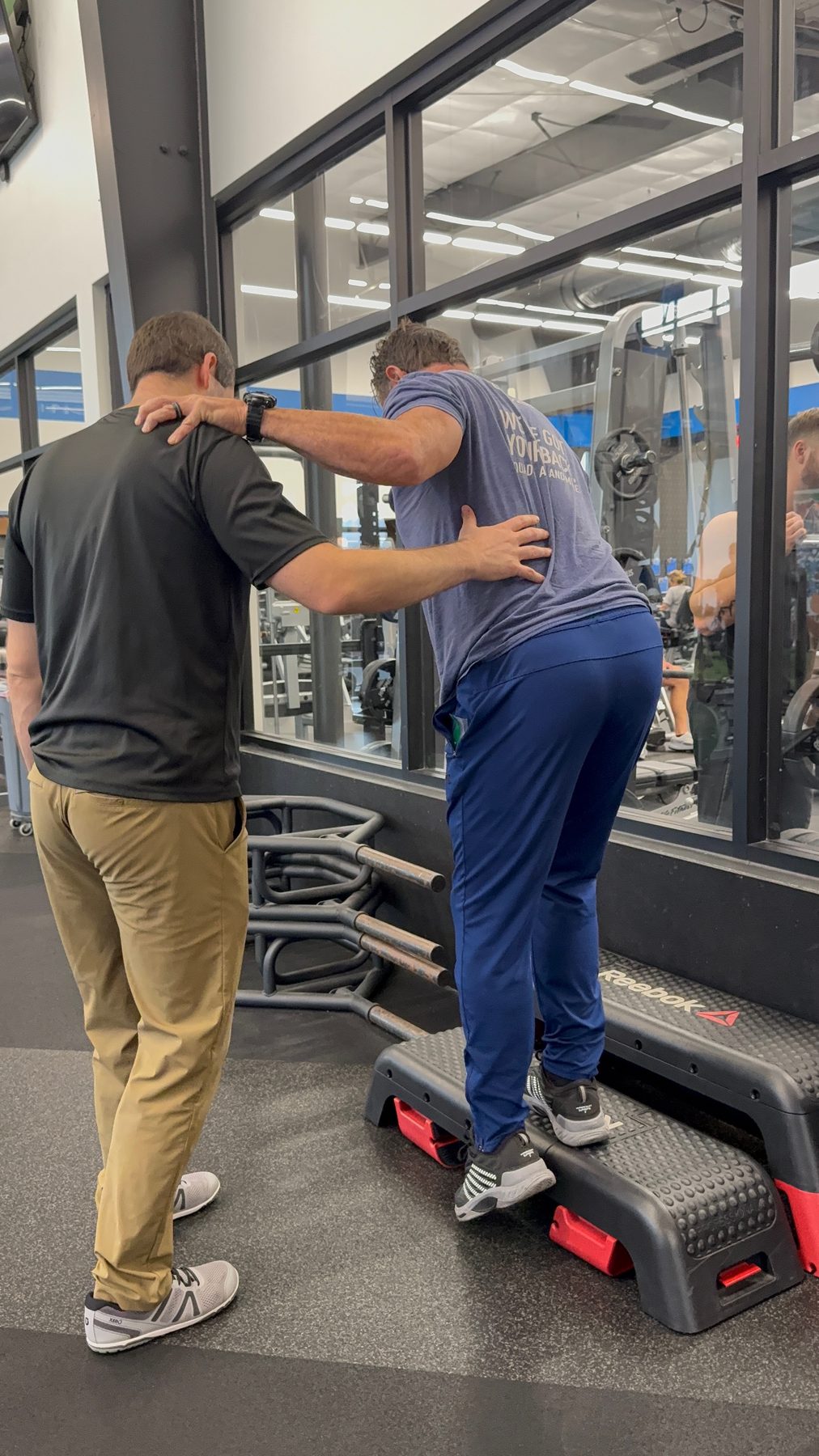
Training is specific and progressive, not wobbly-board theater: narrowing stances, head turns while walking, stepping reactions, dual tasks, and leg strength, dosed to your tested level and advanced weekly. Why balance declines and what reverses it is covered in depth in our guide to why balance gets worse with age.
For the most common causes, yes. A Cochrane review found moderate to strong evidence that vestibular rehabilitation improves dizziness and daily function in inner ear disorders, and repositioning maneuvers resolve most BPPV outright. Central causes and vestibular migraine need a different plan, which is why visit one is a diagnosis, not a guess.
For non-crystal dizziness, the mechanism is recalibration. When one inner ear is weakened, by a virus, a concussion, or age, the brain receives mismatched signals and produces dizziness. Vestibular rehab feeds the brain graded doses of exactly the movements that provoke symptoms, gaze stabilization drills and progressive head motion, and the brain rewires around the deficit. Avoidance does the opposite: the less you move, the longer the mismatch survives.
The post-concussion data deserves its own line. In a randomized trial of athletes with persistent dizziness and neck symptoms after sport-related concussion, 73 percent of the group receiving cervicovestibular rehab were medically cleared within 8 weeks, versus 7 percent of controls. For a Friday night athlete stuck in week 6 of a concussion that will not release them, that is the difference between a season and no season.
One honest note on medication: vestibular suppressants can reduce severe symptoms in some situations, but they do not reposition displaced crystals. Medication decisions belong with the prescribing clinician. Our treatment focuses on identifying the cause and restoring balance, gaze stability, and confidence with movement.
Seven patterns cover most of the dizzy and unsteady patients we see in Lindale and Tyler. Naming the right one is most of the battle.
Brief, intense spinning triggered by position changes: rolling over, lying back at the dentist, looking up at a top shelf. The most common vertigo diagnosis and the most satisfying to treat, usually clearing in 1 to 3 visits with the correctly targeted maneuver. It can recur, and when it does, the same fix works again.
A viral irritation of the inner ear nerve: days of severe spinning and nausea, followed by weeks of motion sensitivity and unsteadiness. The acute phase belongs to your physician. The lingering wobble is where vestibular rehab shines, retraining the brain to trust the weakened side again through graded exposure.
Dizziness, fogginess, screen intolerance, and neck pain that outlast the headline symptoms of a concussion, common in student athletes and after wrecks. The trial evidence above is strong, the neck is almost always involved, and Logan treats the vestibular and cervical drivers together rather than waiting for time to do it.
Episodes of dizziness or motion sensitivity tied to a migraine system, with or without headache, often triggered by screens, stores, and stress. Management is shared: physician-led migraine care plus vestibular rehab for the sensitivity between episodes. Recognizing it matters, because pure repositioning maneuvers will not touch it.
The slow erosion of steadiness that shows up as furniture surfing, a wider stance, and dread of stairs. No single disease, just 3 fading inputs and shrinking practice. It is the most trainable pattern on this page, and the fall prevention numbers in section 02 belong to it.
Rebuilding steady walking and confidence after a stroke, once hospital rehab ends and the real world begins. This is the territory the NCS certification was built for: task-specific gait work, balance progressions, and fall risk management coordinated with your neurologist and family.
Episodes of vertigo with ear fullness, hearing change, or ringing point toward Meniere's disease, which is diagnosed and medically managed by an ENT. Our role is honest triage on the front end and balance rehab between episodes. If your story sounds like this, we will say so at visit one and refer.
When it arrives suddenly with neurological company. Sudden dizziness plus double vision, slurred speech, facial droop, arm or leg weakness, trouble walking, or the worst headache of your life is a 911 call: those are stroke signs. Dizzy for weeks belongs in a clinic. Suddenly dizzy and cannot speak clearly belongs in an ambulance.
The reason for the caution: strokes in the back of the brain can imitate an inner ear problem convincingly, and they are the pattern no one gets to miss. It is also why the evaluation here starts with oculomotor and neurological screening rather than jumping straight to a maneuver. When the eye findings or the story do not fit a peripheral inner ear pattern, Logan refers the same day and sends the exam findings ahead of you.
Visit one is a 60 minute evaluation: oculomotor exam, positional testing, standardized balance measures, and a fall risk score. If BPPV is the answer, treatment starts the same visit and is often resolved by visit 3. Everything else follows a graded plan measured against your baseline numbers.
Visits 2 to 4 build the engine. For nerve-related and post-concussion dizziness that means gaze stabilization homework 2 to 3 times a day, short and frequent beats long and heroic, plus balance progressions and leg strength in clinic. Expect mild, brief symptom provocation during the drills: that is the recalibration signal, dosed on purpose, never a sign the plan is wrong.
Visits 5 to 8 take the gains into the real world: walking with head turns, uneven ground, dim light, busy visual environments, and the specific situations you have been avoiding, the garden rows, the long church aisle, the dock at Lake Tyler, night driving on Hwy 69. We re-test the same measures from visit one so improvement is a number you can see, and you leave with a maintenance program that keeps it.
Care runs at both clinics, Fusion in Lindale and FIT Tyler at 2259 Broussard Street, and no referral is needed to start: Texas direct access (HB 4099) covers up to 30 days of care. Details on our direct access page, the clinical program on our vestibular therapy page, and the local fall picture in our guide to balance and falls in East Texas.
BPPV maneuvers, gaze stabilization, and balance retraining led by a board certified NCS.
Explore AssessmentBalance testing, oculomotor screen, gait assessment.
Explore Your providerBoard Certified Neurological Clinical Specialist.
Team bio
Logan is a board certified neurologic clinical specialist. Vestibular testing, BPPV, and fall prevention programs built for East Texas seniors.
Benign paroxysmal positional vertigo: tiny crystals in the inner ear drift into a canal where they do not belong, and certain head positions send a brief false spinning signal. It is the most common cause of vertigo and is treatable in 1 to 3 visits with a repositioning maneuver.
For most BPPV, yes. A Cochrane review found the Epley maneuver substantially outperforms sham treatment. The step people miss: the maneuver only works when it matches the affected canal and side, which is why we test before we treat instead of guessing from a video.
Most patients see meaningful improvement inside 4 to 8 visits. BPPV often clears in 1 to 3. Nerve-related dizziness and post-concussion cases run longer because the brain needs repeated, graded exposure to recalibrate. We measure progress with the same tests we run at your evaluation.
Yes. In a randomized trial of athletes with persistent symptoms after sport-related concussion, 73 percent of the group receiving cervicovestibular rehab were medically cleared within 8 weeks, versus 7 percent of controls. Post-concussion care is a core part of Logan's practice.
Short term, it can blunt severe spinning. Long term, it works against you: suppressant medication slows the brain recalibration that actually resolves most dizziness, and it does nothing for BPPV crystals. We aim treatment at the cause so you can retire the pill bottle.
Yes, measurably. About 1 in 4 adults 65 and older falls each year, and a Cochrane review of 108 trials found structured balance and strength exercise cuts the rate of falls by about 23 percent. We test your risk with standardized measures and train what the numbers expose.
No. Texas direct access (HB 4099) allows up to 30 days of physical therapy care without a referral, and the evaluation itself sorts inner ear from central causes. When your pattern needs an ENT, neurologist, or imaging, we refer the same week and send our findings ahead of you.
Logan Merritt holds the Neurological Clinical Specialist board certification, held by under 3 percent of US physical therapists, on top of his doctorate. Vestibular testing, BPPV treatment, post-concussion care, and fall risk reduction are the center of his practice, not a sideline.
Busy aisles flood your vision with movement while your inner ear reports you are standing still. When the vestibular system is weakened, that mismatch reads as dizziness. It is a recognized pattern called visual motion sensitivity, and graded exposure training in rehab reduces it.
Book the initial evaluation with Logan. You leave with a diagnosis, a screen result, and a clear timeline. No referral needed.