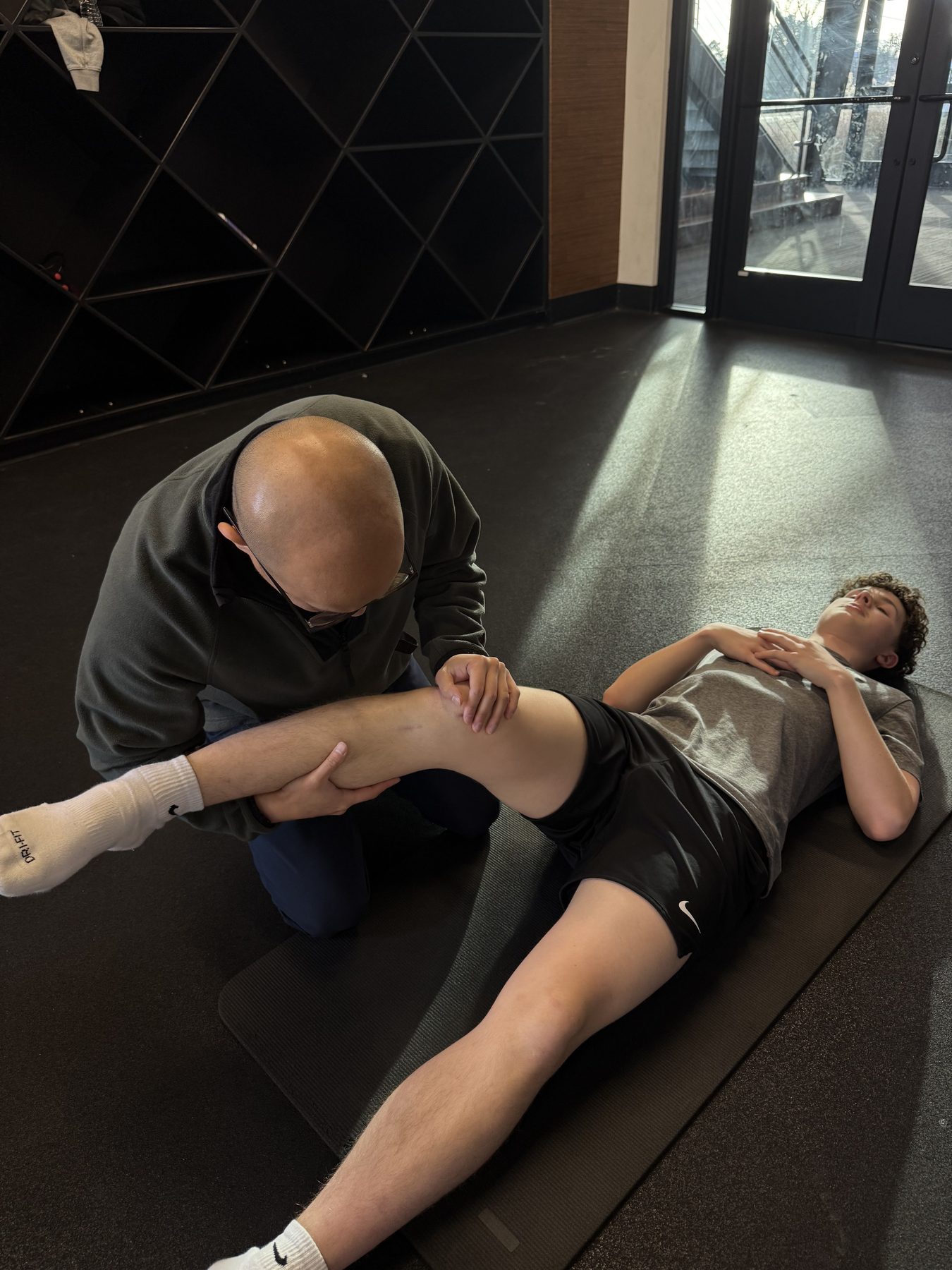
Dry needling
The needle is one tool on a bigger table.
Needling opens the window. Manual therapy, load, and movement carry the result home. That pairing is the whole point.
Dry needling uses a thin filament needle, with no medication on it, to release the muscle knots that months of stretching and massage have not touched. Most patients feel a quick deep cramp called the twitch, mild soreness for 24 to 48 hours, and know whether it is working within 2 to 4 sessions. At Physio+ it is performed only by certified doctors of physical therapy and always paired with active rehab.
Dry needling treats muscle knots (trigger points) with a thin filament needle. The needle carries no medication, which is why it is called dry. It works by triggering a brief twitch in the tight band of muscle, which interrupts the contraction, improves local blood flow, and calms the nerves that keep the knot on.
The name draws the line. A wet needle is a hypodermic that injects something: cortisone, lidocaine, botox. A dry needle delivers nothing at all. The tool itself is a solid filament needle, far thinner than anything used for injections, and the treatment effect comes entirely from where it is placed and what the tissue does in response.
The target is the trigger point, the taut, tender band you call a knot. A knot is not scar tissue or a mystery lump. It is a patch of muscle fibers stuck in contraction, running low on oxygen, and irritating the nerves around it, which is why it aches at rest, hurts when pressed, and often refers pain somewhere else entirely. Knots in the upper traps refer into the head. Knots in the glutes refer down the leg and get blamed on the spine.
That 3 level model, described across the dry needling literature, is also the honest boundary of the tool: the needle changes the muscle's state, not the reason it got that way. A knot fed by weak scapular muscles or a poorly loaded hip will re-form. Which is why, at Physio+, needling is never a standalone ritual. It opens a window, and the rehab that follows is what keeps it open.
Less than most people expect, but we will not pretend it is nothing. The needle itself is 0.16 to 0.30 millimeters thick, and insertion is usually barely felt. The twitch is the part people talk about: a quick, deep cramp that lasts about a second and eases as the knot lets go.
There are 3 sensations, in order. First, insertion, which most patients rate at 0 to 1 of 10; the filament is a fraction of the width of an injection needle, and many people cannot tell the exact moment it goes in. Second, a dull, deep ache as the needle reaches the knot, the same you-found-it quality as deep pressure in a good massage. Third, the twitch.
Honestly described, the twitch response is a quick involuntary cramp: the taut band contracting and releasing around the needle. It can make a leg jump or a shoulder flinch, and it feels strange in a way that resists description until you have felt it. Most patients call it intense for about a second, and a surprising number call it satisfying, the knot losing a grip it has held for months. The twitch is not punishment. It is the clinical sign we are in the right spot, and it correlates with the treatment doing its job.
You are in control the whole session. Needles are typically in and working within minutes, not an hour, and if you want a pause or a stop, we pause or stop. Nobody earns a trophy for white-knuckling a treatment, and tense muscles needle worse anyway.
Same style of needle, different everything else. Acupuncture comes from traditional Chinese medicine and places needles along meridians to influence energy flow. Dry needling comes from Western anatomy and places the needle into a specific dysfunctional muscle you can name on an MRI. Different framework, different training, different goals.
The confusion is fair: the rooms look similar and the needles are identical. The practices underneath are not. Acupuncture is a complete system from traditional Chinese medicine, built on meridian maps and the flow of qi, practiced by licensed acupuncturists whose training runs over 1,000 hours inside that framework. Dry needling grew out of Western trigger point research from the 1940s onward, and its map is the anatomy textbook: muscles, nerves, referral patterns documented in cadaver and imaging studies.
The goals differ the same way. An acupuncturist selects points to rebalance a system. We select one muscle because your exam showed it is guarded, weak, and referring pain, and we can tell you its name, why it is involved, and which test will prove it changed. The intent is functional: restore the muscle so it can be loaded, strengthened, and put back to work.
This is a distinction, not a verdict. If you want acupuncture, see a licensed acupuncturist. If a specific knot is blocking your recovery and you want it treated inside an exam-driven rehab plan, that is dry needling's lane, and it is the only lane we drive in.
Most patients know within 2 to 4 sessions, and some feel a change the same day. Trials on neck and shoulder knots show measurable pain relief immediately after a session, with gains that build over a short series. If nothing has shifted by session 4, we change the plan instead of selling you more needles.
Session 1 is diagnostic in both directions: it tells us how your tissue responds, and it tells you what the treatment actually feels like. Some patients stand up off the table with the knot quiet and range of motion visibly restored. That same-day change happens most with newer, simpler knots and less often with patterns that have had years to dig in.
The typical arc: a noticeable change by session 2, a durable change by session 4, spaced about a week apart while the strength work catches up. Chronic patterns sit at the slow end of that range, and a muscle that has guarded for a decade rarely surrenders in one visit. What should never happen is an open-ended subscription to needles with no measured progress.
That is why we put a checkpoint at session 3 to 4 on purpose. We retest the numbers from your evaluation: pressure sensitivity, range, strength, and your own 0 to 10 report. Better means continue. Flat means the needle is not earning its place in your plan, and it comes out of the plan. There is no punch card.
Very safe in trained hands. In a prospective survey of 7,629 treatments by credentialed physical therapists, zero significant adverse events occurred. The risks that make headlines, like a punctured lung, are avoided by anatomy knowledge and needle angle, which is exactly what certification trains. We screen everyone, and some patients should skip it.
Let us take the 2am search fear head on. Pneumothorax, a needle nicking the lung, is the complication people find on forums, and it is real, rare, and almost entirely technique-dependent. Prevention is not luck. Over the ribcage, needles are inserted at a shallow angle, directed along the rib rather than between and downward, at depths mapped to your build. A certified provider knows exactly where the lung lives and never points a needle at it. That is the honest answer to the fear: technique plus credentials, not reassurance.
What the safety data actually shows: across thousands of documented treatments, the common side effects are bruising (about 8 percent), small bleeds at the site, and next-day soreness. All mild, all short-lived. Significant events in the published surveys of trained providers: zero. The qualifier trained is doing real work in that sentence, which is why the right question for any provider, anywhere, is where they did their needling coursework. Ours will happily answer.
Who should not get it, or should get a modified version: patients in the first trimester of pregnancy, people on blood thinners or with bleeding disorders, anyone with lymphedema in the treatment area, active skin infection at the site, a significantly compromised immune system, certain implanted electrical devices when stimulation is planned, and anyone with a genuine needle phobia. That last one is not a challenge to overcome. We have other tools, and the 5 minute screen at your evaluation sorts all of this before a needle is ever opened.
Post-needling soreness is the most common side effect: a deep, bruised-muscle ache in the treated spot that shows up within hours and fades within 24 to 48. It feels like the day after a hard workout because the mechanism is similar. Movement, water, and heat shorten it. Sharp or spreading pain is not normal, call us.
The soreness is not a sign something went wrong. The twitch is a real muscular event, and a muscle that just released a months-old contraction responds the way it would to unaccustomed exercise: a local inflammatory cleanup, a day or two of tenderness, then quiet. Patients who train hard recognize the feeling immediately. Patients who do not sometimes mistake it for a setback, which is why we tell you before the first session, not after.
What helps: easy movement the same day (walking counts), water, and heat from day 2 onward. What does not: poking the spot hourly to check if it still hurts. What is not normal and warrants a call: sharp pain, spreading redness or warmth, fever, shortness of breath, or soreness still climbing past 72 hours. The number is 903.492.5215, and we want that call early, not late.
Patients who combine needling with spinal adjustments often ask whether the soreness stacks. It mostly does not, and the pairing has its own logic, covered in our library piece on dry needling with adjustments.
The strongest evidence sits with neck and shoulder knots, tension headaches, low back muscle pain, tennis elbow, plantar fasciitis, and the stubborn trigger points massage only quiets for a day. It helps least when muscle is not the driver, which is why we examine first and needle second.
The research base has grown up around specific patterns. Meta-analyses of trigger point needling for neck and shoulder pain show measurable relief immediately after treatment and out to the medium term. A 2021 multicenter trial found that adding perineural electrical dry needling and spinal manipulation to standard care produced better outcomes for cervicogenic headache than exercise and mobilization alone. Reviews across musculoskeletal conditions land on the same summary we give patients: real effects on pain and sensitivity, strongest when needling rides alongside exercise instead of replacing it.
In our clinics, the muscles we needle most: upper traps and levator scap for neck pain and headache referral, QL and glute medius for low back and hip patterns, forearm extensors for tennis elbow, calves and plantar fascia drivers for heel pain, and the hamstring or calf knots that stall an athlete's return to sprinting. Referrals come to us from chiropractors, coaches, and more than one CrossFit gym whose members talk.
If your specific question is back pain, we wrote a dedicated piece on dry needling for back pain, including where it fits alongside the rest of a back rehab plan. This page stays on the how-it-works questions; that one gets specific.
At Physio+ a cash dry needling session is $120, or $400 for a package of four, which works out to $100 a session. Insurance is a separate question: some carriers cover dry needling inside a physical therapy plan of care, some carve it out as a separate code, and some exclude it entirely. We verify your benefits before your first visit so the answer arrives before the bill, and the full cash rate table is published.
The variance is maddening but explainable. Dry needling has its own billing codes (CPT 20560 and 20561), and every plan makes its own call: bundle them into the physical therapy plan of care, pay them separately, or exclude them outright. Two patients on the same insurer with different employer plans can get different answers. Nobody can honestly quote you a universal number, so be suspicious of anyone who does.
Our promise is the boring one: we check your specific benefits before your first visit and tell you the number up front. If your plan excludes needling, it becomes a disclosed cash add-on inside your plan of care, and HSA and FSA funds apply. No surprise line items 6 weeks later.
The front door is the same as everything at Physio+: the initial evaluation. The evaluation determines whether needling belongs in your plan at all, because paying anything for the wrong tool is the real overcharge. Send your insurance details to hello@physioplustx.com or call 903.492.5215 and we will run the verification before you ever come in.
Three things: who holds the needle, how it is placed, and what happens after. Our doctors of physical therapy are certified through dedicated postgraduate coursework, we use a perineural approach that targets the nerves feeding the muscle rather than chasing knots blind, and every session is paired with active rehab.
Who holds the needle: a doctor of physical therapy with a needling certification earned through dedicated coursework and supervised practice, on top of doctoral training in anatomy. Tim Hu, PT, DPT, OCS, C-DN carries board certification in orthopedics alongside the certified dry needling credential. In a treatment where technique is the safety margin, the letters are not decoration.
How it is placed: we practice a perineural approach. Instead of only chasing the knot you can feel, we needle along the nerves that feed the dysfunctional muscle, often adding gentle electrical stimulation through the needles, the method studied in recent multicenter trials. The twitch tells us we found the knot. The perineural work addresses why the nerve kept it switched on.
What happens after: movement, every time. The 20 minutes following needling are a window where the muscle accepts load it refused an hour earlier, and we spend that window loading it. Needles never fly solo at Physio+, because a released muscle that is never strengthened books its own return appointment.
Ready to try it? Book dry needling in Lindale and Tyler through the service page, or start with the initial evaluation at either location: 140 E Eagle Spirit Dr in Lindale, or inside FIT Tyler at 2259 Broussard Street.
Needling opens the window. Manual therapy, load, and movement carry the result home. That pairing is the whole point.
It is not new and it is not magic. Meta-analyses show real, measurable pain reduction for neck, shoulder, and back trigger points, strongest when needling is combined with exercise. It is a tool with evidence behind it, not a cure-all, and we will tell you honestly if you are not a fit.
A quick, deep cramp, like the muscle grabbing for half a second and letting go. Most patients describe it as strange rather than painful, and many say it hurts good, the way a deep massage finds the exact spot. The twitch is the sign we found the knot that matters.
It depends on the muscle: a few millimeters in the jaw or forearm, up to a few centimeters in the glutes or low back. Depth is dictated by anatomy, which your therapist maps before the needle moves. Over the ribs and lungs, we angle shallow and along the rib by protocol.
Serious events are rare and technique-dependent. A survey of 7,629 treatments by trained physical therapists recorded zero significant adverse events. Around the ribcage we use shallow, angled insertions that never point at the lung. This is exactly why credentials matter: ask any provider where they trained before they needle you.
No. They share the same thin filament needle and nothing else. Acupuncture places needles along traditional meridians to influence energy flow. Dry needling places them into a specific muscle trigger point based on your exam, to change how that muscle and its nerves behave. Different training, different map, different goal.
A flare of soreness for 24 to 48 hours is common and usually settles on its own. Feeling wiped out the evening after is also reported. If pain is sharp, spreading, or lasts past 72 hours, call us at 903.492.5215 so we can reassess the plan before your next session.
We screen everyone first. We avoid or modify needling for patients in the first trimester of pregnancy, on blood thinners or with bleeding disorders, with lymphedema in the area, with active skin infection, with certain implanted devices, or with a strong needle phobia. The screen takes 5 minutes at your evaluation.
It depends on your plan. Some cover it inside a physical therapy plan of care, others exclude the code and it becomes a small cash add-on. We verify your benefits before your first visit and tell you the number up front. Email hello@physioplustx.com or call 903.492.5215 and we will check.
Book the initial evaluation. You leave with a diagnosis, a plan, and an honest answer on whether dry needling belongs in it.