Chronic pain and arthritis
Strength is the drug.
Every plan we write ends in load. Not because we love gyms, but because muscle is the only shock absorber your joint can grow more of.
You have been told you are bone on bone, that your joints are worn out, that this is just getting older. The evidence disagrees. Guideline-backed physical therapy reduces arthritis pain, matches surgery head to head in randomized trials for some knees, and still works after years of chronic pain. Most Physio+ patients measure real improvement inside 6 weeks.
Yes. In a randomized trial of 351 patients with meniscal tears and arthritis, physical therapy matched arthroscopic surgery at 6 and 12 months. In another, PT beat cortisone injections at 1 year. Bone on bone describes an X-ray. It does not predict how much pain you have to live with.
Bone on bone is the phrase patients carry out of imaging appointments like a sentence. Here is what it actually means: the cartilage space between two bones looked narrow on one flat image taken on one day of your life. Here is what it does not mean: that movement is dangerous, that exercise is pointless, or that a replacement is the only exit.
Imaging and pain match far more loosely than most people assume. In population studies, a large share of adults whose X-rays show moderate to severe arthritis report little or no daily pain, while plenty of people in real pain have unremarkable films. Strength, body weight, sleep, activity dose, and how sensitized your nervous system has become all move the pain needle, and every one of them is trainable. The X-ray is the one thing on that list we cannot change, and it is also the weakest predictor.
A Physio+ chronic pain evaluation takes 60 minutes with a doctor of physical therapy. We test what your joint actually tolerates instead of guessing from the X-ray, then build a plan around graded strength work, manual therapy for the stiff segments, dry needling for the guarded muscle around the joint, and subzero cryotherapy for high-flare days. For the full deep dive on treating knee arthritis without surgery, read our guide to the natural path for knee arthritis.
Good. In a 2022 study of more than 1,000 adults with knee arthritis, people who walked for exercise developed new frequent knee pain less often than those who did not: 26 percent versus 37 percent. Walking was also linked to slower structural worsening on X-ray. The joint rewards use.
The mechanism matters, because it explains why parking the joint backfires. Cartilage has no blood supply. It feeds through compression: every step squeezes fluid and nutrients through the tissue the way wringing a sponge moves water. Walk regularly and the joint stays lubricated, the muscles that shield it stay strong, and stiffness stays down. Sit still for a week and all 3 move the wrong direction.
Dose is where most people go wrong, in both directions. Start with a distance you are confident you could repeat tomorrow, even if that is 10 minutes on flat ground. Use the next-morning rule: if the knee is noticeably worse the next morning and stays worse past midday, yesterday's dose was too big. If it feels the same or better, hold the dose for a week and then add roughly 10 percent.
There are days walking is the wrong tool. A hot, swollen, actively flaring joint wants a bike, a pool, or a shorter loop, not a hero session. That is not quitting. That is rotating tools while the flare passes, and it is exactly the kind of judgment call we coach you through in the first month.
No. This is the misconception that keeps more arthritic knees weak than any other. A 2019 analysis of 103 randomized trials ranked exercise, especially aerobic work, as the most effective non-drug treatment for knee and hip arthritis pain. Loading cartilage within its tolerance signals it to adapt, not erode.
The wear-and-tear picture treats your knee like a car tire with a fixed number of miles on it. Living tissue does not work that way. A 2017 review across more than 114,000 people found hip and knee arthritis in 3.5 percent of recreational runners versus 10.2 percent of non-runners who stayed sedentary. The people using their joints the most had arthritis the least. Tires do not do that.
Muscle is the other half of the answer. Your quads and hips are the shock absorbers that spend force before it ever reaches the joint surface. When pain makes you move less, those muscles shrink, more load lands directly on the joint, and the pain grows. That spiral, not the arthritis itself, is what most patients are actually stuck in when they reach us.
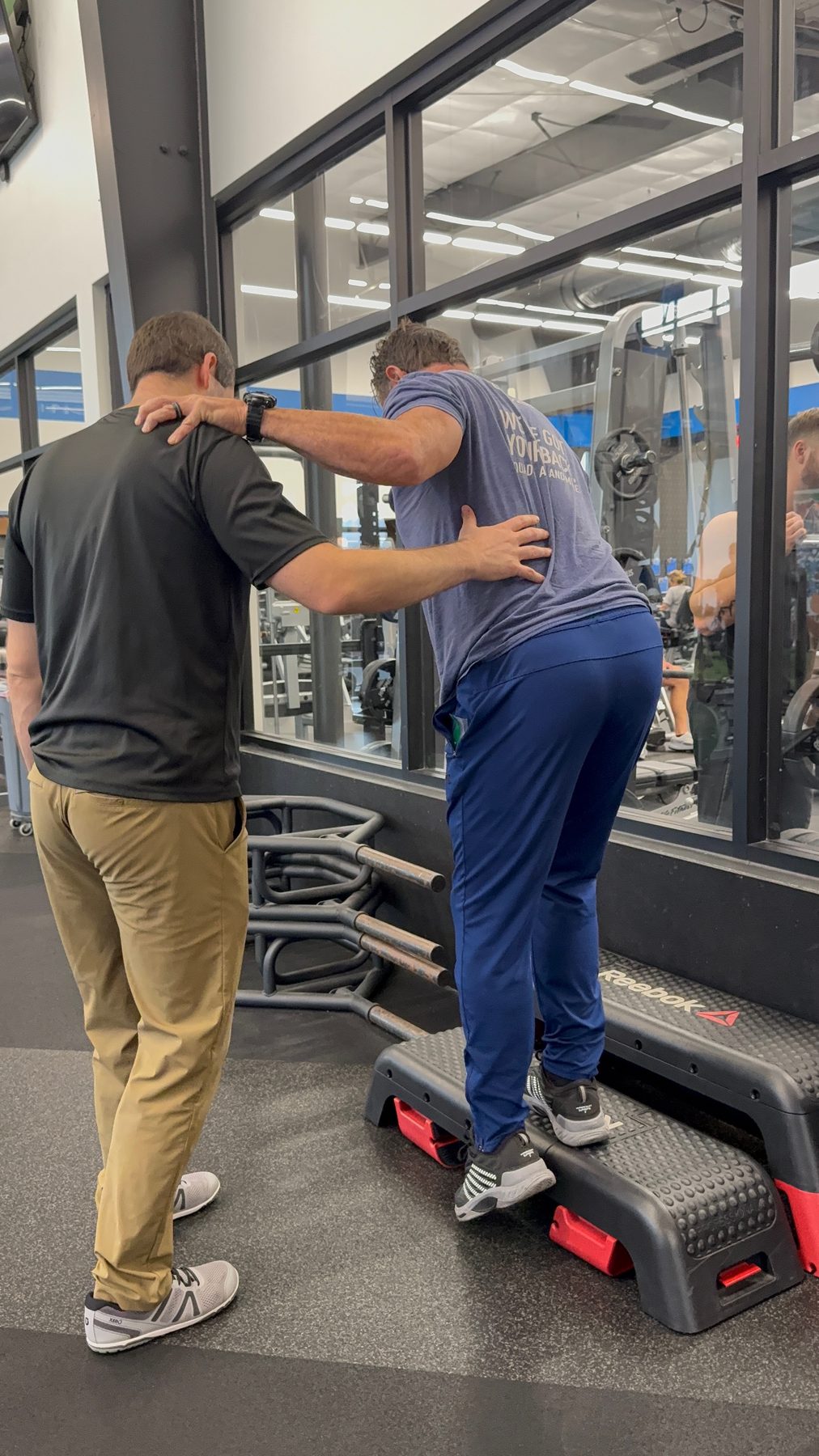
Reversing it takes 2 strength sessions a week: leg press, sit-to-stands, step-ups, loaded within your tolerance and progressed as it grows. Our clinics sit inside working gyms, so you rehab on the same equipment you will keep training on after discharge.
Often. In a Danish randomized trial of 100 patients whose knees qualified for total replacement, 3 of 4 assigned to exercise-based care had still not needed surgery a year later. Some knees do need a replacement. Our job is to make sure yours actually is one before anyone books an operating room.
This is sequencing, not surgery avoidance as an ideology. Every major guideline calls for a real trial of exercise-based care before replacement is considered, and insurers increasingly require documented conservative care first. A real trial means 10 to 12 weeks of progressive, supervised loading, not a printed sheet of 3 stretches from 2019. Most patients who tell us PT already failed them never received the first version.
If the knee does end up needing replacement, the work is not wasted. Patients with stronger quads going into surgery consistently show better function coming out. The rehab you do now is the prehab that shortens the recovery later, which is why we treat it as a no-lose investment either way.
And when the honest answer is surgical, we say so. Night pain that survives 12 weeks of well-dosed rehab, a joint that has stopped responding to load, function falling instead of rising: that pattern earns a surgical consult, and we will help you get one. The full decision framework is laid out in our guide to treating knee arthritis naturally.
The wrong dose will. The right dose does the opposite. A 2017 Cochrane review found aerobic exercise improves pain, function, and quality of life in fibromyalgia, and exercisers were no more likely to drop out than non-exercisers. The difference between a flare and progress is dosage, not effort.
If a past program flared you, the program was probably built for a different nervous system. Fibromyalgia amplifies signals: normal post-exercise soreness gets read as threat, and the system responds with a flare. That is a real physiological event, not weakness and not imagination. It also does not mean exercise is off the table. It means the entry dose has to sit below your flare threshold, which is usually far lower than any generic plan assumes.
Our starting rule: take what you can do on a good day and begin at roughly half of it. Warm water work and recumbent cycling are common first tools because they load the system gently and predictably. From there we build over 4 to 6 weeks, holding each step until your body accepts it. Boring by design. Boring is what progress looks like when the alternative is the flare cycle.
You also leave with a written flare plan: what to shrink, what to keep, and when to resume the build. Flares stop being derailments and become speed bumps with a procedure attached.
Boom and bust is the cycle where one good day tempts you into 3 big days, which cost you 5 flat ones. We replace it with quota pacing: activity set by plan instead of by morning mood. You do the quota on good days and bad days alike, then raise it about 10 percent a week.
Letting symptoms drive the schedule feels sensible and fails predictably. On good days you overshoot, because you are catching up on your life. On bad days you shut down, because everything hurts. The average workload trends toward zero while the crashes grow, and after a few months you are doing less than ever and hurting more than ever. Nearly every long-term chronic pain patient we meet is somewhere in that loop.
Quota pacing inverts it. Say you can walk 12 minutes before symptoms climb. Your quota starts at 8, daily, regardless of how you feel. Good day: 8 minutes, stop while you feel fine, which quietly retrains your nervous system to associate activity with safety. Bad day: still 8, shrunk to 4 if the flare is real, never zero. Each week the number creeps up. Within 2 months most patients are doing more on their worst days than they used to do on their best.
We track the numbers with you visit to visit, and we time manual therapy and cryotherapy around the build so recovery keeps pace with the load.
Cortisone works, briefly. Typical relief runs 4 to 8 weeks. In a 2-year randomized trial, injections every 3 months produced more cartilage loss than saline with no added pain relief. Gel injections carry a conditional recommendation against in the 2019 ACR guideline. Neither one builds strength, and strength is the currency.
We are not anti-injection. A single well-timed cortisone shot that calms a hot joint enough to sleep, and enough to start loading, can be the smartest move on the board. What we push back on is the injection treadmill: a shot every 3 months, each one buying a little less time, with nothing changing in between. The 2-year trial data suggests that pattern may cost cartilage while delivering no durable relief.
Gel injections (hyaluronic acid, often sold as rooster comb shots) have weaker trial support than most patients are told at the counter. Some people feel better for a stretch. The pooled evidence was unconvincing enough that the ACR guideline conditionally recommends against them for knees. If you have had one and it helped, we will not argue with your knee. We will just make sure the window it bought gets spent on strength rather than on the calendar.
The same honesty applies to surgery. Replacement is an excellent operation for the right joint at the right time, and when your exam says it is time, we will tell you directly and coordinate with your physician. Until then, the sequence that protects you is load first, needle second, blade last.
Every plan we write ends in load. Not because we love gyms, but because muscle is the only shock absorber your joint can grow more of.
No. X-ray severity and pain match poorly: some bone on bone knees hurt a little, some mild ones hurt a lot. Strength, sleep, body weight, and activity dose all change pain, and all of them are trainable. Living with arthritis is realistic. Living with this pain level usually is not.
Aerobic exercise ranked first for pain and function in a 2019 network meta-analysis of 103 trials. Walking, cycling, and pool work all count. Strength work for the quads and hips comes a close second. The best program mixes both at a dose you can recover from.
Cortisone typically buys 4 to 8 weeks of relief, and repeated use may accelerate cartilage loss. Gel (hyaluronic acid) injections carry a conditional recommendation against in the 2019 ACR guideline because trial results are weak. Either can make sense once, as a bridge into active rehab.
Flares track with activity spikes, poor sleep, stress, and weather swings more than with new joint damage. A bad day does not mean the arthritis progressed overnight. We chart your flare pattern in the first 2 weeks so you can predict and shorten flares instead of fearing them.
Shrink the dose, not the habit. 5 minutes of walking or pool work daily beats 45 minutes once a week followed by a crash. We find your current tolerance, start 20 percent below it, and raise it weekly. Most patients double their activity inside 8 weeks.
Yes. Long-standing pain involves a sensitized nervous system on top of the original tissue problem, and both respond to graded activity. Progress is slower than with a fresh injury, measured in months rather than weeks, but the age of your pain does not disqualify you from improving.
Probably, modestly. Studies link falling barometric pressure and temperature with small increases in arthritis pain. Cold also stiffens tissue and shrinks activity, which matters more. A warm-up routine and an indoor backup plan for cold snaps blunt most of the East Texas winter effect.
No. Texas direct access law (HB 4099, effective September 2025) allows up to 30 days of physical therapy care without a physician referral. You can book the initial evaluation directly. If anything in your exam needs a physician, we refer you the same week.
Book the initial evaluation. You leave with a diagnosis, a paced plan, and your first exercises. Years of pain do not disqualify you.