Neck and head
Neck pain. And the jaw too.
Tech neck, TMJ, and cervicogenic headaches get treated together, because they travel together. Full cervical exam, cranial nerve screen, and a ramp back to your desk.
Most neck pain we treat in Lindale and Tyler comes from muscles and joints working overtime, not from damage. A locked-up morning neck usually settles inside 2 weeks, arm tingling from a pinched nerve usually calms without surgery, and neck-driven headaches respond to targeted treatment: roughly 7 in 10 patients cut headache frequency at least in half in the landmark trial. Physio+ treats the pattern, not just the knot.
Check 3 signs: the headache starts at the base of the skull and wraps forward on one side, neck movement or long desk hours trigger it, and the top few neck joints are stiff or tender when pressed. That pattern is a cervicogenic headache, and it responds to treatment aimed at the neck, not the head.
The mechanism is referral. The top 3 joints of your neck share nerve wiring with the back of your head, so an irritated upper cervical joint can produce pain you feel behind the eye or across the temple. Patients spend years treating those headaches with medication aimed at the head while the driver sits 4 inches lower, untouched.
The evidence here is unusually clean. In a randomized trial of 200 patients with cervicogenic headache, the group receiving exercise plus manual therapy cut headache frequency at least in half in roughly 7 in 10 cases, and the results held at 12 months. Migraine and tension-type headaches are different animals, but both can carry a neck component worth screening, which is why the evaluation starts with sorting your headache type before treating anything.
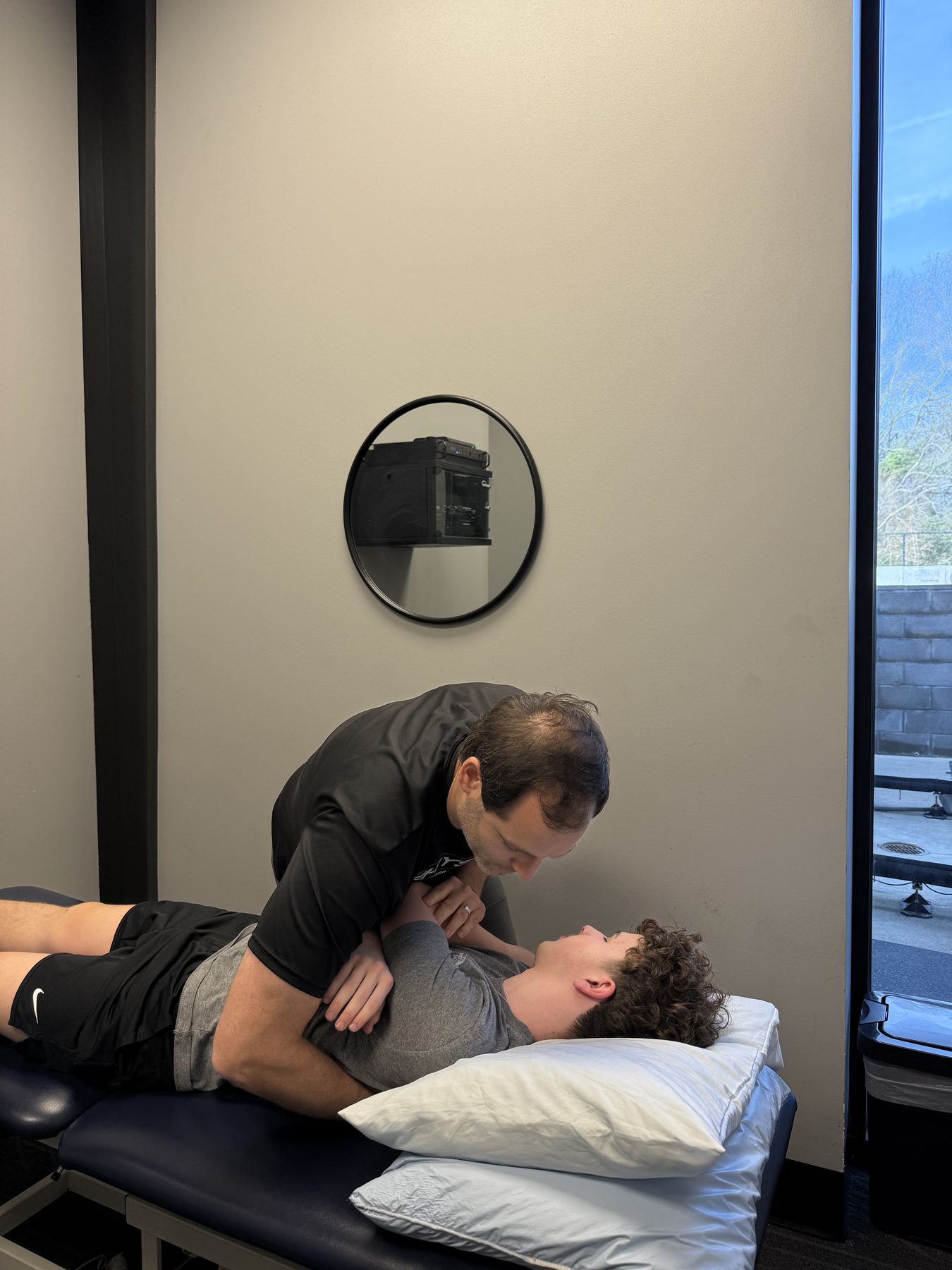
A Physio+ neck evaluation includes cervical movement testing, a neurological screen, and hands-on assessment of the joints that refer to the head. Plans may combine manual therapy, dry needling, deep neck flexor strength work, and Physio+ Adjustments when manipulation is indicated.
Keep it moving gently and give it 24 to 72 hours. A true wry neck is a muscle and joint spasm, not damage: rotate as far as comfortable every hour, use heat 15 minutes at a time, and skip the self-cracking. Most cases free up within days and settle fully inside 1 to 2 weeks.
What not to do matters as much as what to do. Do not force the locked direction: the spasm is guarding, and bullying it deepens the guard. Do not knead the most painful spot for 20 minutes, which usually leaves it angrier. And do not move into a recliner for a week. The fastest resolutions we see belong to people who keep gently visiting the edge of the stiff range, dozens of times a day, letting the nervous system stand down on its own schedule.
If the lock-up keeps recurring, the pattern usually lives upstream: a pillow that holds your head tilted all night, a desk that keeps you rotated toward a second monitor, or a stiff mid-back forcing the neck to do all the turning on the commute down Hwy 69. Those are fixable inputs, and they are exactly what we evaluation at the evaluation.
One boundary: a stiff neck with fever, after real trauma, or with tingling spreading down the arm is not a crick. That combination gets examined, and the red flags section below spells out where to go.
Tingling that runs below the elbow into specific fingers usually means an irritated nerve root in the neck, what most patients call a pinched nerve. The outlook is better than it feels: in a long-term population study, about 90 percent of people recovered with little or no lasting problem, most without surgery.
The fingers are a map. Tingling toward the thumb points to one nerve level, the middle finger to another, the pinky side to a third. Your exam matches that map against strength testing and reflexes to name the level involved, which is most of what an MRI would tell us, without the wait or the bill.
Treatment is about making room and calming the root: positions and mobility work that open the nerve passage, nerve glide exercises dosed below the flare line, and graded strength work as symptoms recede. Arm pain typically retreats up the arm as things improve, shoulder-ward, which is a progress sign we track visit to visit.
Two findings change the plan: weakness that is progressing, like a grip that keeps dropping things week over week, and any sign the spinal cord itself is irritated. Both trigger a physician referral, and we make that call with you, not after you.
Six patterns cover most of the necks that walk through our doors in Lindale and Tyler. Named the way patients name them, translated once.
The ache that builds across the afternoon, worst between the shoulder blades and up into the skull, gone on vacation and back by Tuesday. It is a workload problem: small muscles holding your head forward for 8 hours. Strength, posture variety, and a smarter desk fix it, and our complete tech neck guide is the full prescription.
Headaches generated by the upper neck joints and referred to the skull, usually one-sided, starting at the base of the head and wrapping forward. The tell is that neck position and movement change them. Covered in depth in section 01 above, because they are the most missed diagnosis on this page.
An irritated nerve root sending pain, tingling, or numbness down the arm, sometimes with weakness. Usually caused by a disc or bony narrowing at one level. Most cases recover with conservative care over weeks to a few months, and the exam tracks exactly which ones need imaging or a surgical opinion.
The delayed stiffness and pain after a rear-end collision, common on the I-20 corridor, often arriving a day or two after the wreck. Early guided movement beats collars and rest in the research, and early treatment also lowers the odds of symptoms becoming chronic. Bring the crash story: mechanism matters to the plan.
Waking with the head stuck toward one shoulder and a hard stop in one direction. Alarming, common, and benign in almost every case: a joint and muscle spasm that releases over days. Section 02 above is the playbook, and hands-on treatment in the first 72 hours usually shortens the worst of it.
Age-related joint and disc change, present on most X-rays after 60 whether the neck hurts or not. The painful version shows up as morning stiffness, a shrinking comfortable range, and grinding with rotation. Mobility plus strength is the treatment, and the imaging report is the least useful page in the chart.
Rarely, and the exceptions are worth memorizing. Go to an emergency department for fever with a neck too stiff to flex, arm or leg weakness that is spreading, new clumsiness in the hands or trouble walking, a thunderclap headache, or dizziness with slurred speech or vision change. In Tyler, that means CHRISTUS Trinity Mother Frances or UT Health East Texas, or call 911.
The hand clumsiness and gait items describe cervical myelopathy, pressure on the spinal cord itself rather than a single nerve root. It tends to creep rather than announce itself, which is exactly why it is on this list: caught early, outcomes are far better.
Everything above is a small minority of neck pain. Screening for it, including a neurological and cranial nerve screen, is built into every Physio+ intake, and when something does not fit the mechanical pattern we refer the same day and tell you exactly what we saw.
Three phases across 4 to 8 weeks for most cases. Weeks 1 to 2 calm the pain and restore turning range. Weeks 3 to 4 build the deep strength your neck has been missing. Weeks 5 to 8 make the gains hold up against your actual life: the desk, the gym, the drive.
Weeks 1 to 2 are hands-on heavy: joint mobilization for the stiff segments, dry needling for the trap and levator knots that have not released in months, and 2 to 3 precise exercises, not a sheet of 12. We also evaluation the inputs: pillow height, monitor position, and the rotation habits your workday forces. Most patients report the first measurably better week inside this phase.
Weeks 3 to 4 target the deep neck flexors, the small stabilizers that quietly resign during years of desk work, plus the mid-back mobility and scapular strength that decide how much load reaches your neck at all. This is the phase that separates lasting results from a massage that wears off by Friday, and we re-test your baseline numbers at every second visit.
Weeks 5 to 8 load the system on purpose: carries, rows, overhead work in the gym, and full desk days without the 3 p.m. ache. Both clinics sit inside working gyms, Fusion in Lindale and FIT Tyler at 2259 Broussard Street, so the transition from rehab to training happens on the same floor. Where a headache pattern is the main complaint, this phase also confirms the frequency drop is holding before discharge.
No referral is needed to start: Texas direct access (HB 4099) covers up to 30 days of care. Details are on our direct access page, or go straight to booking the initial evaluation.
Tech neck, TMJ, and cervicogenic headaches get treated together, because they travel together. Full cervical exam, cranial nerve screen, and a ramp back to your desk.
Not in most cases. The forward position overworks muscles and joints; it does not reshape your spine. The fix is posture variety, strength, and mobility, not a new spine. Our tech neck guide covers the desk setup and the exercise progression we use most.
One that keeps your head level with your chest, in line with the rest of your spine. Side sleepers usually need a thicker pillow, back sleepers a thinner one, and stomach sleeping is the position we coach people out of first. We fit this during your evaluation.
Only when clinically indicated and only with your consent. Cervical manipulation is one tool among several, and gentler mobilization achieves comparable results for most patients. We explain what we recommend and why before anything happens, and no plan depends on it.
Often, yes. Tingling that runs below the elbow into specific fingers points to an irritated nerve root in the neck, what most people call a pinched nerve. Most cases recover without surgery. We screen the nerve on intake and track strength week to week.
A true wry neck, the morning lock-up, usually frees up in days and fully settles inside 1 to 2 weeks. Treatment shortens the worst early phase. A stiff neck with fever, trauma, or spreading arm symptoms is a different problem: get that one examined.
For neck-driven headaches, yes. In a 200-patient randomized trial, exercise plus manual therapy cut headache frequency at least in half for roughly 7 in 10 patients, with results holding at 12 months. The first step is confirming your neck is actually the driver.
We recommend against making it a habit. The pop is gas releasing in a joint, the relief is real but short, and repeated self-manipulation tends to keep an irritable segment irritable while the stiff segments nearby stay stiff. Targeted mobility work gives longer relief.
Most mechanical neck pain plans run 6 to 10 visits over 4 to 8 weeks. Nerve root cases and long-standing headache patterns run longer. We set a measurable goal at visit one and re-test every 2 weeks, so you always know whether it is working.
No. Texas direct access law (HB 4099, effective September 2025) allows up to 30 days of physical therapy care without a physician referral. You can book the initial evaluation directly. If anything in your exam needs a physician, we refer you the same week.
Book the initial evaluation. You leave with a diagnosis, 2 to 3 exercises, and a clear timeline. No referral needed.