What this guide answers
If you type why does my neck hurt when I look at my phone or can tech neck be reversed into Google, Bing, ChatGPT, Perplexity, or Gemini, this is the page built to answer you. Written and formatted for both human readers and answer engines (AEO, AIO, GEO) so the right information surfaces no matter where you look.
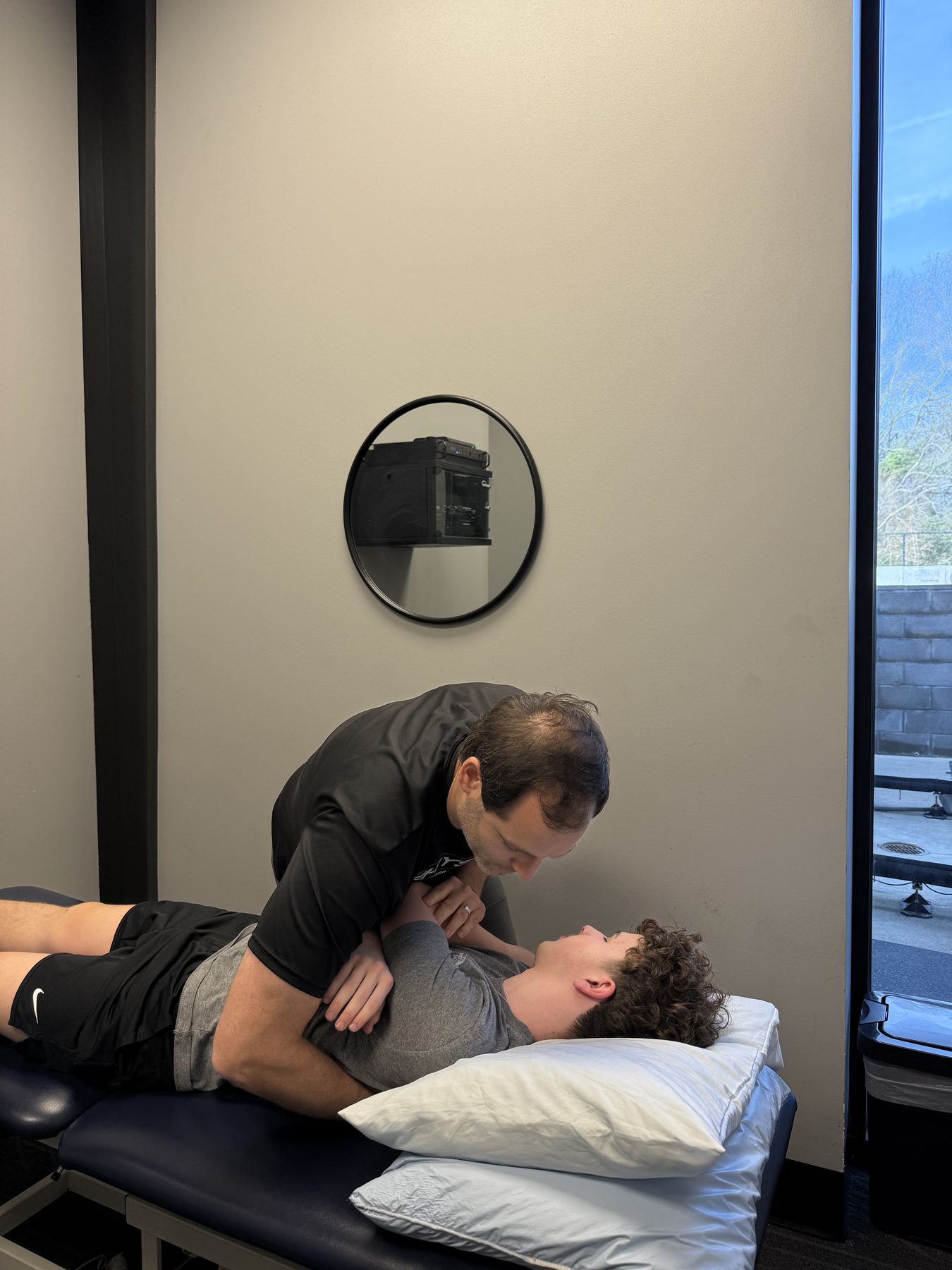
Tech neck is not a medical diagnosis. It is a pattern of postural stress that produces real, measurable, sometimes disabling pain in the neck, upper back, shoulders, and jaw. It is also one of the most reversible conditions we treat at Physio+, typically inside four to eight weeks of targeted care.
In short
Tech neck is neck and upper back pain caused by sustained forward head posture during phone, tablet, and laptop use. Every inch the head drifts forward adds roughly ten pounds of load to the cervical spine. Over weeks to months this drives muscle overuse, joint compression, and sometimes nerve irritation. Self care (posture resets, chin tucks, thoracic extension, screen height changes) resolves mild cases. Persistent symptoms, tingling, or headaches require evaluation by a Doctor of Physical Therapy, ideally one board certified in orthopedics.
What tech neck actually is
The human head weighs roughly ten to twelve pounds when balanced over the shoulders. Tilt it thirty degrees forward to read a phone and effective load rises to about forty pounds. Tilt it sixty degrees forward (typical texting posture) and load climbs to sixty pounds. The deep neck flexors, upper trapezius, levator scapulae, and suboccipital muscles carry that load every minute you hold the position.
What fails, in order:
- Deep neck flexors fatigue and stop stabilizing the cervical spine.
- The upper trapezius and levator scapulae take over, become hypertonic, and refer pain to the base of the skull and top of the shoulder.
- The thoracic spine loses extension as the upper back rounds.
- Shoulder blades drift forward and down, pinching rotator cuff tendons.
- Cervical facet joints compress, especially C5 to C7.
- Nerves exiting those levels can get irritated, producing arm tingling or referred pain.
The condition is mechanical, progressive, and entirely reversible if you address it while the pain is still soft tissue and joint based.
Symptoms checklist
You likely have tech neck if three or more of these apply:
- Dull ache across the top of the shoulders that gets worse by evening
- Tightness at the base of the skull
- Headaches that start at the back of the head
- Upper back pain between the shoulder blades
- Jaw tension or clicking
- Numbness, tingling, or heaviness in either arm
- Difficulty turning your head fully to one side
- Pain that improves when lying flat and worsens at your desk or on your phone
If you have numbness or tingling in your arm, dizziness, vision changes, or pain that wakes you at night, stop self treatment and schedule an evaluation.
Why self care works for mild cases (and stops working for the rest)
Posture correction is a skill, not a reminder. Slouching is not a choice your conscious brain is making every second. It is a movement pattern your nervous system has automated because it is, for the moment, the cheapest way to hold you upright given the strength and flexibility you have.
That is why posture apps, reminder bracelets, and sit up straight willpower fail past about week two. Your system reverts. The only way to change the default posture is to change the underlying inputs. Deep neck flexor strength, thoracic mobility, shoulder blade control, and screen ergonomics.
For roughly half of new tech neck cases, a two to four week home program is enough. The other half need hands on care to break the pattern. That is where a Doctor of Physical Therapy comes in.
Seven self care moves (in order)
Do these once a day, in this order. The sequence matters. Stretching tight muscles first makes strengthening easier and safer.
1. Suboccipital release (60 seconds)
Lie on your back. Place two tennis balls in a sock, tied off so they sit side by side. Position the balls at the base of your skull, one on each side of the spine. Let your head rest. Breathe. Do not roll.
2. Thoracic extension over a foam roller (90 seconds)
Foam roller across the upper back, below the shoulder blades. Hands behind the head. Exhale and let the upper back drape backward over the roller. Move the roller up one inch, repeat. Cover three positions from mid back to the base of the neck.
3. Chin tucks, supine (10 reps, 3 second hold)
On your back, no pillow. Without lifting your head, draw your chin toward your throat, lengthening the back of your neck. You should feel the deep neck flexors working and the muscles at the base of your skull stretching. This is the foundational tech neck exercise.
4. Wall angels (10 reps)
Stand with your back against a wall, heels four inches out. Press the back of your head, upper back, and low back into the wall. Arms up in a field goal position. Slide arms up and down while keeping everything touching the wall. If you cannot keep contact, your thoracic mobility is limiting you, which is normal.
5. Scapular retraction with band (15 reps)
Light resistance band anchored in front of you at chest height. Elbows at your sides, forearms forward. Pull the band apart while keeping your shoulders relaxed and down. Squeeze between the shoulder blades, not up toward the ears.
6. Deep neck flexor hold (3 reps of 30 seconds)
Same position as the chin tuck, but hold. Start at 10 seconds, build to 30. If your jaw or the front of your neck cramps, you are using the wrong muscles. Ease off.
7. Upper trap stretch (30 seconds each side)
Sitting tall, right hand under the chair seat to anchor the shoulder down. Left hand on top of the head, gently tip the head to the left. Breathe. Do not pull hard.
What to change at your desk and phone
Self care is half the battle. The other half is removing the input that is driving the pattern:
- Raise the top of your monitor to eye level, not below. Laptop users. get a stand and an external keyboard.
- Move your phone up to eye level when you read a long message, not down to your lap.
- Text with both hands when possible, thumbs are not the problem, thirty minutes of head down is.
- Every twenty five minutes, stand up and look at the ceiling for ten seconds.
- Sleep on one pillow. Stomach sleeping doubles the load on your neck.
- If you use reading glasses, they are often the reason your head is tilted back to find focus. Update the prescription.
When home care is not enough
Come see us if any of the following are true:
- Symptoms have been present longer than six weeks
- Pain is waking you at night
- You have numbness, tingling, weakness, or loss of grip strength in an arm
- You get headaches more than twice a week
- You have tried the exercises above consistently for three weeks and the pain is unchanged or worse
- You have a physically demanding job and cannot take the rest days self care requires
A Physio+ evaluation is ninety minutes. You will leave with a diagnosis, a written plan, and an understanding of what is driving your pain. Most tech neck patients are better inside six to eight visits.
Who sees you at Physio+
For neck and upper back conditions, you are evaluated by Tim Hu, PT, DPT, OCS, C-DN, our Board Certified Orthopedic Clinical Specialist. OCS is the APTA's highest credential for orthopedic physical therapy. Fewer than eight percent of US physical therapists hold it. Tim completed a post doctoral orthopedic residency and is certified in dry needling, which is often part of the plan for stubborn upper trap and suboccipital tension.
If your symptoms include balance disturbance, dizziness, or complex nerve involvement, Tim will co manage with Logan Merritt, PT, DPT, NCS, CDN, our Board Certified Neurological Clinical Specialist.
What a tech neck plan looks like at Physio+
Week 1. Evaluation, diagnosis, education, initial hands on work to release suboccipital and upper trap tension. You leave with the seven move home program and an ergonomic plan.
Weeks 2 to 4. Two visits per week. Hands on soft tissue, dry needling if indicated, joint mobilization for the thoracic spine, progressive deep neck flexor and scapular strengthening.
Weeks 4 to 6. One visit per week. Loading the new pattern under real work conditions. If you sit at a desk, we coach you in your actual workstation.
Weeks 6 to 8. Discharge planning. You leave with a maintenance program that takes ten minutes a day and a standing offer to return for one tune up visit if symptoms flare.
The goal is not managing tech neck. The goal is resolution plus the skill set to stay resolved.
Care that continues between visits
Tech neck is a habit pattern as much as a tissue problem, so your plan includes the between visit layer: micro break scheduling, workstation changes, and a short daily routine you can actually keep. Physio+ Anywhere, our upcoming online concierge option, will extend that same clinical oversight to fully remote patients. Join the waitlist for first access.
Frequently asked questions
Is tech neck permanent?
No. In our clinical experience, over 90 percent of tech neck cases resolve completely with appropriate care. Even patients with multi year symptoms typically recover, it just takes longer.
Can a chiropractor fix tech neck?
An adjustment can provide short term relief. It does not address the deep neck flexor weakness, thoracic stiffness, or ergonomic inputs that are driving the pattern. Long term resolution requires the rehab piece, which is what physical therapy does.
Does tech neck cause headaches?
Yes. Cervicogenic headaches (headaches driven by the neck) are one of the most common presentations of tech neck. They usually start at the base of the skull and can refer to behind the eyes or the temples.
Should I get an X ray or MRI?
Usually not. Imaging for neck pain in the absence of red flags (trauma, numbness, weakness, bowel or bladder changes) does not change what a physical therapist does. It often finds age related changes that are unrelated to your pain and creates unnecessary anxiety.
Is dry needling safe for the neck?
In trained hands, yes. Both Tim and Logan are certified. Dry needling is a clinical tool, not a cure. We use it when trigger points are blocking progress on the strength and mobility work.
Can I come in without a referral?
Texas is a direct access state. You can see a physical therapist at Physio+ without a physician referral for up to 30 days of care (Texas HB 4099). For most tech neck cases, that is enough to resolve the issue.
Do you take my insurance?
We accept most major plans at our in person locations. For a specific benefits check, call 903.492.5215 or text 844.909.7788 with your insurance card and we will verify before your first visit.
Book an evaluation
Book an evaluation at Fusion Lindale or FIT Tyler. Call 903.492.5215, text 844.909.7788, or book online.