In short
Basketball players tear ACLs during landing and change of direction, not during contact. The four exercises with the strongest evidence for ACL prevention are Nordic hamstring curls, single leg Romanian deadlifts, lateral bounds with stick landings, and jump landings with perfect mechanics. Run them three days a week, 12 weeks before season. At Physio+ Sport Performance in Lindale and Tyler, we build this into our basketball athlete programming.
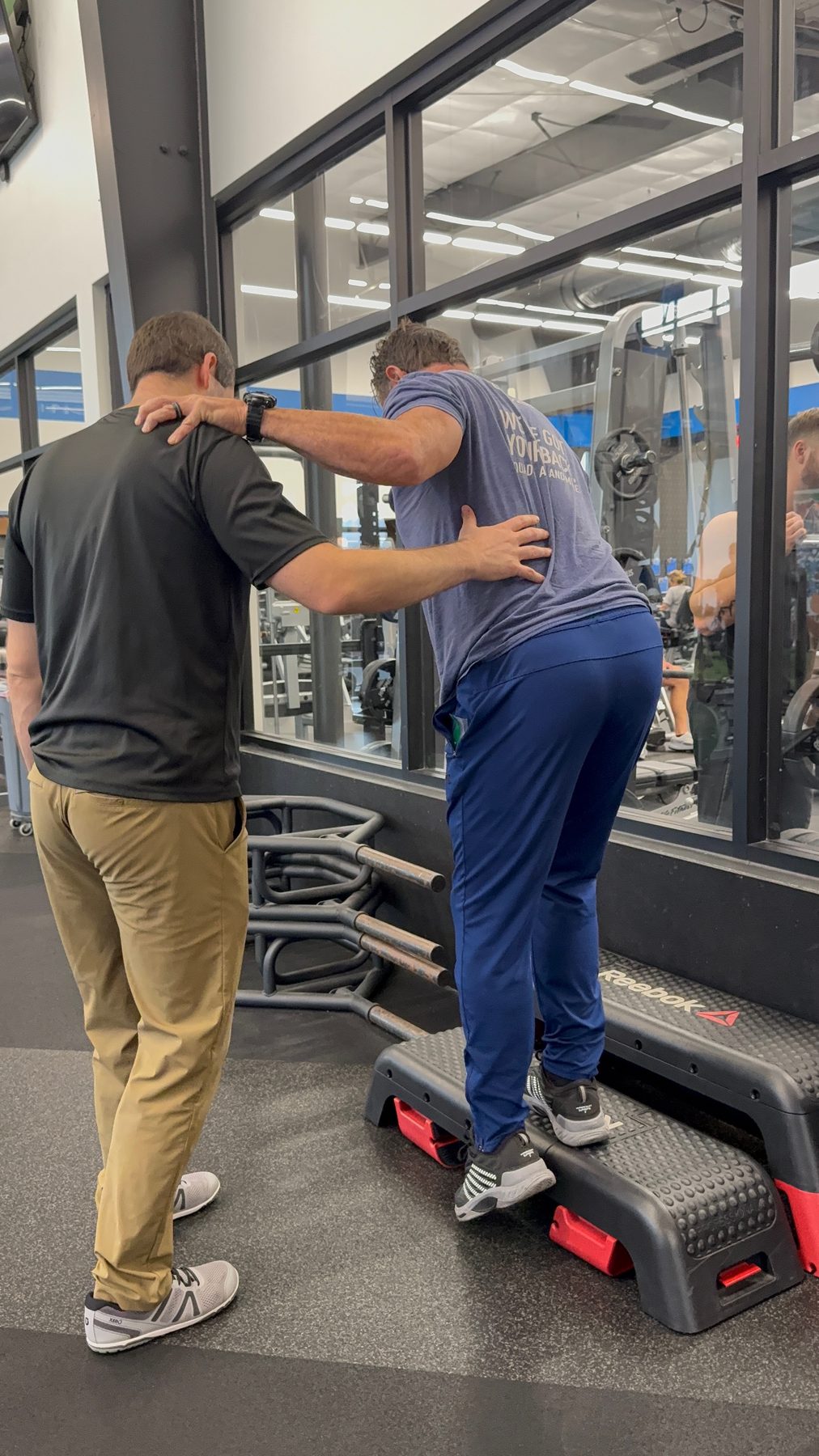
Why do basketball ACLs tear?
Because of how players land and cut, not because of contact. About 70 percent of ACL injuries happen without any contact at all. Two scenarios dominate.
- Landing from a jump with the knee caved inward and the foot out of line.
- Planting hard to change direction with the knee in valgus (caving in).
The knee does not fail because it is weak in the straight plane. It fails because the hip and ankle let the knee drift out of line. A prospective study of over 500 athletes found that weak hip muscles more than doubled the risk of a non contact ACL tear. Female athletes carry 2 to 8 times the risk of males, driven by landing mechanics, hip strength, and neuromuscular timing rather than anything unfixable. Prevention trains the hip, ankle, and landing mechanics so the knee stays tracked when the game demands it.
When is the ACL most vulnerable? The 30 degree danger zone
The ACL is most vulnerable when the knee is bent at roughly 30 degrees and two other motions stack on top: adduction, when the knee caves inward toward the midline, and internal rotation, when the knee rotates inward while the foot stays planted. At about 30 degrees of flexion the hamstrings cannot yet protect the ligament and the quadriceps pull the shin bone forward, so the ACL absorbs the strain nearly alone. Add the cave in and the inward rotation and the load concentrates on the ligament at its weakest angle.
That combination shows up in three basketball moments: single leg landings from a jump, cutting hard off a planted foot, and rapid deceleration. Video analysis of real ACL injuries in basketball confirms the pattern. The knee is near 30 degrees, drifting inward, and rotating at the moment of failure. Every exercise below is built to keep the knee out of that position when the game applies force.
Do prevention programs actually work?
Yes, and the effect is large. Multicomponent training programs reduce ACL injury risk by 51 to 67 percent when athletes run them consistently. That is a bigger risk reduction than any brace, sleeve, or shoe on the market. The catch is the dose: the research supports 12 or more weeks at three sessions per week, which is exactly where most teams quit early.
The four exercises
Each of these maps directly to the danger zone above. Two build the strength that keeps the knee tracked, two train the landing and deceleration patterns where tears actually happen.
1. Nordic hamstring curl
Kneel with ankles locked under a heavy object or held by a partner. Lower your body forward slowly, resisting gravity as long as you can. Catch yourself with your hands. Push back up.
Programming. Three sets of five reps, twice a week. The eccentric hamstring work is the single best studied ACL prevention exercise in the literature.
2. Single leg Romanian deadlift
Stand on one leg, dumbbell in the opposite hand. Hinge at the hip, sending the free leg back as a counterweight. Return to standing. Ten reps per side.
Programming. Three sets of 8 to 10 per leg, three times a week. Builds the hip and hamstring control that keeps the knee tracked.
3. Lateral bound with stick landing
Stand on one leg. Jump sideways, land on the opposite leg, hold the landing for three seconds without the knee caving inward. Reverse.
Programming. Three sets of six per side, twice a week. Trains the deceleration pattern that most ACL tears happen in.
4. Box jump with mechanics focus
Jump up to a 12 to 18 inch box. Land soft, knees in line with toes, hips back, chest up. Reset every rep.
Programming. Three sets of five, twice a week. The landing is the point, not the height.
Why most ACL prevention programs fail
Two reasons.
- Athletes do them for two weeks and quit. The research supports 12 plus weeks, three sessions per week.
- Coaches cue them generically."Knees out" is not enough. Players need individual feedback on their landing pattern.
At Physio+ we use slow motion video during the first session to identify each athlete's pattern. The cue that fixes one player is different from the cue that fixes another.
When to work with a DPT
- You have had a prior ACL tear (six times higher risk of re tear without proper prevention work).
- You have knee pain that limits your jumping or cutting.
- You want a video based assessment of your landing mechanics.
- You are returning to sport after any knee injury.
What a Physio+ prehab block looks like
Whether you play for Lindale High School, Tyler Legacy, All Saints, or any East Texas program, the structure is the same. Eight to twelve weeks, two visits per week in phase one, one per week in phase two. Sessions run at Fusion Lindale and at FIT Tyler, 2259 Broussard Street, Tyler TX 75701.
- Movement screen and video landing analysis.
- Strength testing (quad, hamstring, glute).
- Progressive exercise plan with the four moves above plus individualized additions.
- Return to sport testing at discharge.
What other basketball injuries do we treat?
The ACL gets the headlines, but it is not the injury we see most. Basketball players in Lindale and Tyler come to us for ankle sprains that never fully rehabbed and keep re rolling, patellar tendinopathy (jumper's knee) from practice volume, meniscus injuries from the same cutting mechanics that threaten the ACL, and hip and groin strains from defensive slides. The prevention work in this guide reduces the risk of most of them, because the same hip strength and landing control protect the whole lower body chain, not just one ligament.
Frequently asked questions
Can I do these on my own?
The exercises are public. Executing them well enough to reduce risk is harder. Most athletes benefit from at least a few sessions with a DPT to dial the form.
What age should we start?
Middle school or high school athletes benefit most. Younger is fine with age appropriate progressions.
Does strength training prevent ACL tears?
Strength alone is not enough. You need the landing and deceleration pieces too.
What if I have already torn my ACL?
A structured return to sport program is critical. Re tear rates are high without one.
How do I know the program is working?
We retest strength and landing mechanics at week six and week twelve. You see the change on video.
How common are ACL injuries in high school basketball?
ACL tears are among the most common serious injuries in basketball at every level. Roughly 70 percent happen without contact, and female athletes carry 2 to 8 times the risk of males. Those numbers are why prevention programs earn their place in a team's weekly schedule.
What are the warning signs of an ACL tear?
A pop at the moment of injury, swelling within the first hours, severe pain, inability to bear weight, and a feeling of instability or the knee giving way. Any of these after a landing or cut means stop playing and get evaluated. Playing on a torn ACL risks meniscus and cartilage damage that complicates the recovery.
How long is recovery after ACL surgery?
ACL reconstruction recovery typically takes 6 to 9 months before returning to basketball, and return to sport testing matters more than the calendar. Athletes who pass strength and hop testing before returning re tear at far lower rates than athletes who return on a date alone.
Book the evaluation
Basketball athlete performance evaluation with Cameron Berry, PT, DPT, CSCS. initial evaluation. Book online.
References
- Hewett TE, Stroupe AL, Nance TA, Noyes FR. Plyometric training in female athletes: decreased impact forces and increased hamstring torques. Am J Sports Med. 1996;24(6):765-773.
- Krosshaug T, Nakamae A, Boden BP, et al. Mechanisms of anterior cruciate ligament injury in basketball: video analysis of 39 cases. Am J Sports Med. 2007;35(3):359-367.
- Sugimoto D, Myer GD, McKeon JM, Hewett TE. Evaluation of the effectiveness of neuromuscular training to reduce anterior cruciate ligament injury in female athletes: a critical review of relative risk reduction and numbers needed to treat analyses. Br J Sports Med. 2012;46(14):979-988.
- Khayambashi K, Ghoddosi N, Straub RK, Powers CM. Hip muscle strength predicts noncontact anterior cruciate ligament injury in male and female athletes: a prospective study. Am J Sports Med. 2016;44(2):355-361.
- Leppanen M, Pasanen K, Kujala UM, et al. Stiff landings are associated with increased ACL injury risk in young female basketball and floorball players. Am J Sports Med. 2017;45(2):386-393.