In short
The face pull to Y is the single most efficient shoulder exercise for overhead athletes. It trains the lower trapezius, posterior deltoid, external rotators, and serratus anterior in one flowing movement, which are exactly the muscles that fail in throwing, swimming, and overhead pressing injuries. Run it three times a week for 12 weeks and most athletes see improved overhead stability and reduced shoulder pain. At Physio+ Sport Performance in Lindale and Tyler, it is a staple for baseball, volleyball, tennis, and swim athletes.
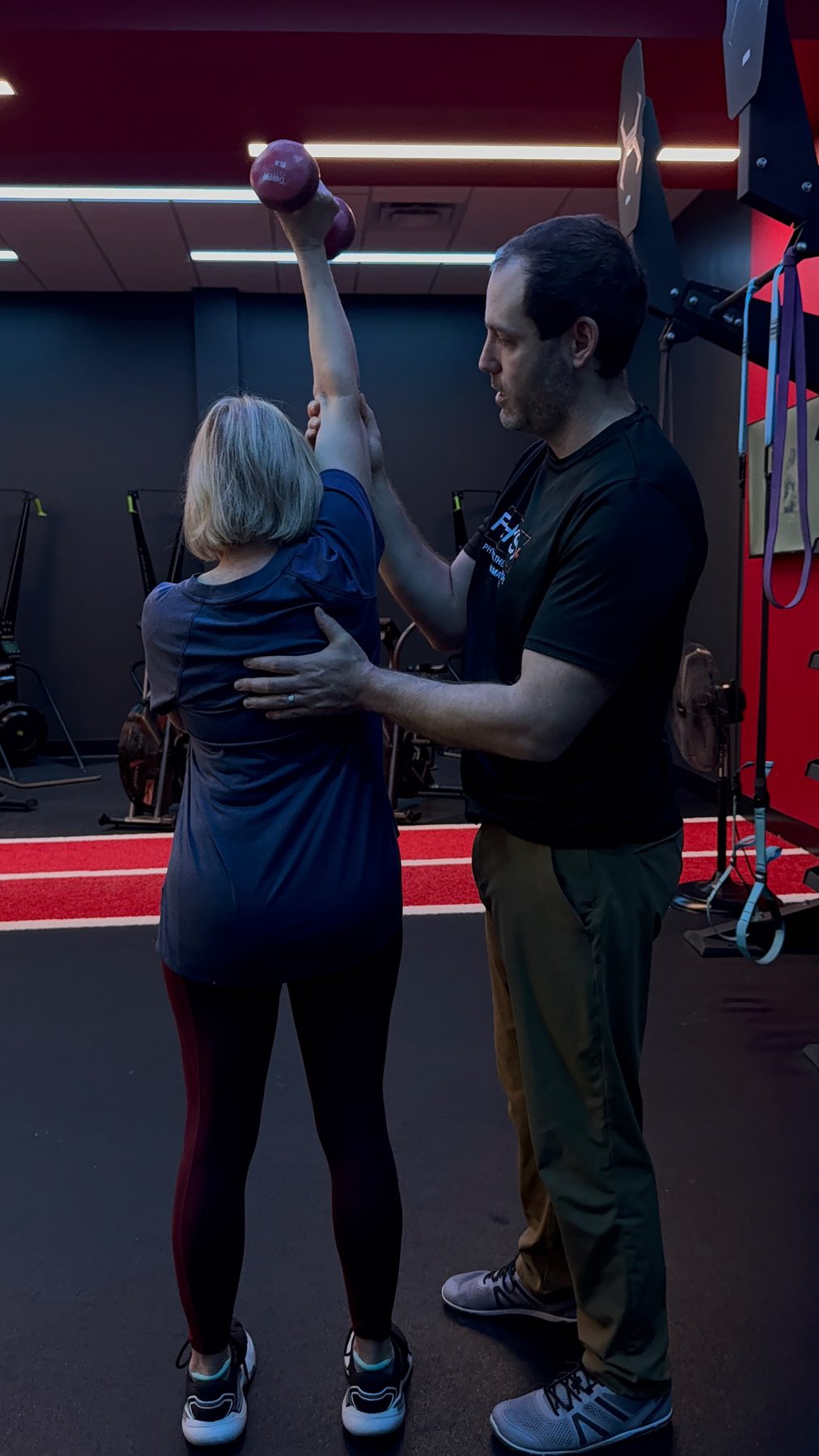
Why is the usual rotator cuff work not enough?
Because isolated band work trains muscles one at a time, and overhead sport never uses them that way. Internal and external rotation with a light band is fine for early rehab. It does not prepare a thrower, swimmer, or overhead lifter for the loads their sport demands. The posterior chain of the shoulder (lower traps, rhomboids, external rotators, posterior delt) has to act in concert, often at high speed and high range. Isolated band work cannot teach that.
The demand is also lopsided. Every overhead sport trains the front of the shoulder constantly: pressing, throwing, pulling through water. Almost nothing in sport or in a typical gym program trains the back of the shoulder at matching intensity. Over a season that imbalance is what turns into impingement, and it is the reason one well chosen posterior chain exercise outworks five random ones.
The face pull to Y, step by step
One movement, two phases, zero equipment beyond a cable or band. Here is the full setup and execution.
- Cable anchored just above your head. Rope attachment.
- Grab the rope palms down, arms extended forward, body leaned back slightly.
- Pull the rope toward your face, elbows out wide, thumbs rotating backward (external rotation).
- Without pause, continue the pull into a Y position. Arms straight up and out, thumbs pointing back over your head.
- Reverse the movement slowly back to the starting position.
Three sets of 10 to 12. Slow and controlled. If your reps look jerky, drop the weight.
Which cues make the face pull to Y actually work?
Four cues separate a productive set from a wasted one. We coach them in this order.
- Let your hands beat your elbows back. This is critical for achieving maximal external rotation at the shoulder, which is the quality most overhead athletes are missing. If the elbows lead, you get a row. If the hands lead, you get rotation.
- Keep the elbows at 90 degrees, no further. Bending past 90 recruits the biceps to do the pulling and takes the work off the posterior rotator cuff and scapular muscles, where it belongs.
- Pull your elbows apart, do not squeeze your shoulder blades together. Squeezing overworks the rhomboids, which are downward rotators of the scapula. Overactive rhomboids interfere with the upward rotation the shoulder blade needs for every overhead position.
- Show your armpits. At the top of the Y, think about showing your armpits to the wall in front of you. It is the fastest way to feel true external rotation instead of a shrug.
Why the two part motion matters
The face pull portion trains external rotation under load, the piece most overhead athletes are weak in. The Y finish trains the lower trap and scapular upward rotation, the piece that keeps the shoulder blade moving correctly through overhead positions. Together they cover the motor pattern overhead sport requires.
There is a coordination benefit too. Sport never isolates external rotation from scapular upward rotation. A pitch, a serve, and a snatch demand both at once. Training them as one flowing pattern teaches the timing, not just the strength, which is why we program this over a face pull and a Y raise as two separate exercises.
What muscles are you actually training?
Four groups, and each earns its place. The lower trapezius upwardly rotates and posteriorly tilts the shoulder blade, keeping the socket pointed where the arm is going. The serratus anterior keeps the blade flush to the rib cage through the overhead arc. The infraspinatus and teres minor externally rotate the ball and hold it centered in the socket at speed. The posterior deltoid handles deceleration when the arm slows from full velocity. Most shoulder routines train none of these well. This one trains all four in a single pattern.
Which sports benefit most?
Any sport that throws, serves, presses, or swims overhead. Here is how the exercise maps to the six athlete groups we program it for most at our Lindale and Tyler clinics.
Baseball and softball
The deceleration phase of throwing, when the arm slows down after ball release, creates massive eccentric force on the posterior cuff and scapular stabilizers. The face pull to Y strengthens those exact muscles in the exact positions throwing stresses them. We program it for nearly every throwing athlete we see, whether they are rehabbing pain or chasing velocity.
Powerlifters and Olympic lifters
The lockout of an overhead press demands strong scapular upward rotation and posterior tilt, which is precisely what the Y position trains. The posterior cuff strength from the face pull portion also protects the shoulder in the bottom position of a bench press and the catch of a clean or snatch.
Football players, especially quarterbacks
Same mechanics as baseball, different projectile. The cocked position before release and the deceleration after release load the posterior shoulder identically. It is not just quarterbacks. Linemen pressing opponents, defensive backs reaching for interceptions, and receivers extending for catches all draw on the same scapular control.
Tennis and pickleball
The cocking phase of the serve loads the posterior shoulder and the follow through demands deceleration control. Racquet athletes usually arrive with a weak posterior cuff relative to the chest and front of the shoulder. This exercise attacks that exact imbalance.
Gymnasts
Handstands, ring work, and bar skills demand shoulder stability in every conceivable position. The Y directly mimics the shoulder position of a handstand, so the scapular upward rotation and posterior tilt trained here transfer straight to the skill.
Swimmers
The recovery phase of freestyle, butterfly, and backstroke places the shoulder in external rotation and scapular upward rotation, the same pattern as the Y. Swimmers develop impingement from muscular imbalance more than from volume alone, and this movement restores the balance that the pull dominant strokes erode.
Not on that list? The rule still holds. If your sport or your job puts your hands above your head under load, the posterior shoulder and scapular control this exercise builds are what keep the joint healthy while you do it.
Programming for athletes
- In season. Three sets of 10 to 12, twice a week. Light load, focus on control.
- Off season. Three to four sets of 12 to 15, three times a week. Moderate load, time under tension.
- Return to throw or return to serve. Daily for the first two weeks, then three times a week.
- Shoulder pain rehab. Two to three sets of 15 to 20, three to four times per week. Light resistance, perfect technique, progress load only as symptoms improve. Higher reps at lighter loads build tendon tolerance without provoking an irritated shoulder.
Rule of thumb. If you do not feel it in the middle traps and the back of the shoulder, your form is off.
Common mistakes
We correct the same four errors in almost every athlete who learned this from a video. Each one quietly shifts the work away from the muscles the exercise exists to train.
- Shrugging up during the pull. The upper trap should be quiet.
- Elbows dropping down toward the ribs. Keep them high.
- Rushing the Y portion. It is the harder piece.
- Using a weight you cannot control. You are training a pattern, not hitting a PR.
When shoulder pain is limiting you already
If you have ongoing shoulder pain, do not add this without a clinical evaluation. Rotator cuff tendinopathy, impingement, labral irritation, and frozen shoulder all look alike at first glance and need different approaches. Most overhead athletes are back to full training inside six to eight weeks of targeted physical therapy.
Frequently asked questions
Will this fix my shoulder pain?
It can prevent the common overuse pattern. If you already have pain, start with an evaluation. The exercise is part of the return phase, not the start.
How much weight should I use?
Enough that the last two reps feel challenging with perfect form. For most athletes that is 15 to 25 pounds.
Is it safe for a labral repair?
After clearance from your surgeon and DPT. Typically cleared around 12 to 16 weeks post op.
How often should I do this?
Three times a week is the sweet spot for most athletes.
Can I do this with bands if I do not have a cable?
Yes. Anchor a band overhead and follow the same pattern.
Build the plan with Cameron
Overhead athlete evaluation with Cameron Berry, PT, DPT, CSCS. Movement screen, throwing or serving assessment, written plan. initial evaluation. Book online.