In short
Most shoulder pain is treatable without surgery. Rotator cuff tendinopathy, impingement syndrome, frozen shoulder, and labral irritation all respond to targeted physical therapy. Surgery is indicated for true full thickness tears in active patients and select labral injuries, not for most pain presentations. At Physio+ in Lindale and Tyler, shoulder patients are seen by Tim Hu, PT, DPT, OCS, C-DN. Most plans resolve inside eight to twelve weeks.
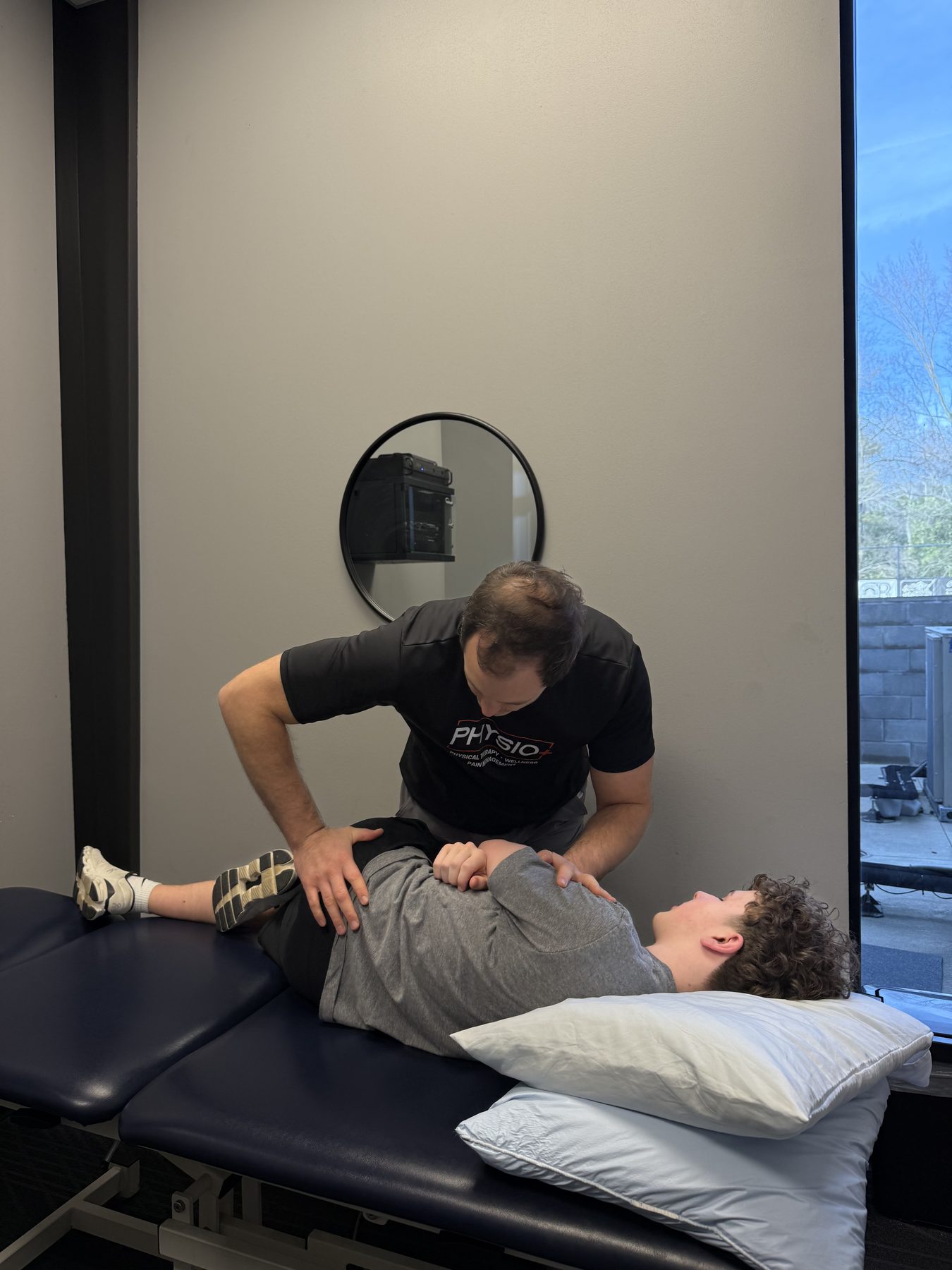
The six most common shoulder diagnoses we see
Shoulder pain is a symptom, not a diagnosis. The plan that fixes a frozen shoulder makes an impingement worse, which is why naming the problem correctly on day one matters more than any exercise list. These six cover over 90 percent of what walks through our doors.
- Rotator cuff tendinopathy. Pain with overhead reaching, worse at night on the affected side. 60 percent of cases we see.
- Subacromial impingement. Pinching pain at a specific arc of motion (usually 60 to 120 degrees of elevation).
- Frozen shoulder. Gradual loss of motion, often painful, typical in patients 40 to 60. Common after a trivial injury or period of inactivity.
- Labral irritation. Deep pain, catching, or instability. More common in athletes and younger patients.
- AC joint pain. Point tender at the top of the shoulder. Often from a fall onto the shoulder or heavy overhead pressing.
- Referred pain from the neck. Shoulder pain that is actually coming from a cervical disc or facet. Worth ruling out on day one.
What causes most shoulder pain
- Posture driven scapular dysfunction.
- Rotator cuff weakness and imbalance.
- Thoracic spine stiffness limiting overhead motion.
- Overuse patterns in overhead athletes or lifters.
- Sleeping on the affected side.
- Prior injury that never fully rehabbed.
Why does shoulder pain happen? The three hidden drivers
Most shoulder pain traces back to three mechanical problems working together: impingement, rotator cuff weakness, and poor scapular control. They rarely show up alone, and treating only one is why so many shoulder plans stall. Here is how each one works.
Impingement. The crowded elevator
Your rotator cuff tendons travel through a narrow space between the ball of the shoulder and the bony roof above it. Picture an elevator shaft where the cables need to glide freely up and down. When the walls close in on those cables, they start rubbing and fraying. That is impingement. The space narrows, the tendons pinch on every overhead reach, and irritation builds rep by rep until even reaching for a coffee cup lights it up.
Weak rotator cuff. The loose wheel bearing
The rotator cuff's real job is not lifting the arm. It is keeping the ball of the shoulder centered in the socket while the bigger muscles do the lifting. Think of a car wheel that should spin perfectly centered on its axle. When the bearings that keep it centered start to fail, the wheel wobbles, and every mile of driving wears it further. A weak cuff lets the arm bone drift upward and forward in the socket, which shrinks the tendon space and feeds the impingement above.
Poor scapular control. The unstable ladder
Your shoulder blade is the platform your entire arm works from. Picture painting a ceiling while standing on a wobbly ladder. Your arms can be strong, but the unstable base makes every stroke harder and riskier. When the muscles that steer the shoulder blade fire late or fatigue early, the socket stops following the arm, overhead clearance drops, and the rotator cuff works overtime just to keep the joint centered.
Why does shoulder pain get worse instead of better?
Because the three drivers feed each other like dominoes. A weak rotator cuff lets the arm bone shift upward, which creates impingement. Impingement causes pain, which makes you avoid certain movements. Avoiding movement weakens the cuff further and throws off your shoulder blade mechanics. Poor shoulder blade control then reduces the clearance space even more, worsening the impingement. It is a downward spiral, and waiting it out usually means sliding further down it.
The encouraging part: breaking the cycle at any single point starts the healing process. That is what a structured rehab plan does, and it is why patients who have hurt for a year still respond.
How do we break the cycle? The three pronged approach
Every Physio+ shoulder plan attacks all three drivers at once instead of chasing one. We restore the tendon space with manual therapy and thoracic mobility work, rebuild rotator cuff strength with progressive loading, and retrain scapular control so the platform holds under real world demand. Fixing one leg of the triangle gives temporary relief. Fixing all three is what keeps the pain from coming back.
Red flags that require medical workup
- Sudden severe pain after a fall, especially with visible deformity.
- Inability to lift the arm at all after trauma.
- Numbness or tingling down the arm.
- Fever with shoulder pain.
- Chest or jaw pain with shoulder pain (rule out cardiac).
Self care for mild cases
If your pain is under six weeks old, there is no night pain, and your range of motion is close to normal, start here. Five moves, once a day, two to four weeks. Improvement should be steady week over week. If it is not, stop guessing and get evaluated.
1. Doorway stretch
Forearm on the door frame, arm at 90 degrees. Step forward. Hold 30 seconds per side.
2. Sleeper stretch
Side lying on the painful shoulder, arm out at 90 degrees. Other hand gently pushes the forearm toward the floor. Hold 30 seconds.
3. Band external rotation
Elbow tucked, rotate the forearm outward against light band resistance. 15 reps, three sets.
4. Prone Y
Lying face down, lift arms into a Y position with thumbs up. Ten reps, three sets.
5. Scapular wall slides
Back to the wall, arms in a field goal. Slide up and down, keeping contact with the wall. 10 reps.
When self care is not enough
- Symptoms past six weeks.
- Night pain that wakes you.
- Progressive loss of range of motion.
- Numbness or tingling.
- History of frozen shoulder on the other side.
Does exercise therapy actually work for shoulder pain?
Yes, and the numbers are strong. Across systematic reviews, 70 to 85 percent of people with rotator cuff related shoulder pain get significant relief through properly targeted exercise rehabilitation, without injections or surgery. Scapular focused programs in particular outperform general exercise for impingement presentations. The catch is the word targeted. Random YouTube shoulder routines train the muscles that are already strong and skip the ones that are failing. The exercise selection has to match your specific driver, which is what the evaluation is for.
What a Physio+ plan looks like
Week 1. Evaluation. Differential diagnosis. Written plan. Hands on work for thoracic mobility and scapular reset. Home program.
Weeks 2 to 5. Two visits per week. Manual therapy, dry needling for periscapular muscle guarding, progressive rotator cuff and scapular strengthening.
Weeks 6 to 8. Loading phase. Overhead work, pushing and pulling patterns, return to specific activities (lifting, throwing, sport).
Weeks 8 to 12. Discharge. Home program for long term shoulder health.
Overhead athletes and lifters
If you throw, hit, swim, or lift overhead, the face pull to Y is the single best accessory we program. See that guide for the details, or talk with Cameron Berry at Sport Performance.
Frequently asked questions
Do I need an MRI?
Usually not. Most shoulder diagnoses are made clinically. MRI is ordered when surgical consideration is on the table.
Will I need surgery?
Most patients will not. Full thickness rotator cuff tears in active patients are the main surgical category. Partial tears and most other diagnoses respond to rehab.
What about a cortisone injection?
Can help a flare short term. Repeated injections weaken tendon. We discuss timing with your physician as part of your plan.
Is frozen shoulder really frozen forever?
No. Most frozen shoulders resolve in 12 to 18 months. A good rehab plan cuts that timeline significantly.
Who should I see first?
Start with a DPT evaluation unless you have red flag symptoms.
Book the evaluation
initial evaluation with Tim Hu, PT, DPT, OCS, C-DN. Book online.
References
- Bury J, West M, Chamorro-Moriana G, Littlewood C. Effectiveness of scapula focused approaches in patients with rotator cuff related shoulder pain: a systematic review and meta analysis. Man Ther. 2016;25:35-42.
- Hanratty CE, McVeigh JG, Kerr DP, et al. The effectiveness of physiotherapy exercises in subacromial impingement syndrome: a systematic review and meta analysis. Semin Arthritis Rheum. 2012;42(3):297-316.
- Kibler WB, Ludewig PM, McClure PW, et al. Clinical implications of scapular dyskinesis in shoulder injury: the 2013 consensus statement from the Scapular Summit. Br J Sports Med. 2013;47(14):877-885.
- Littlewood C, May S, Walters S. Epidemiology of rotator cuff tendinopathy: a systematic review. Shoulder Elbow. 2013;5(4):256-265.
- Struyf F, Nijs J, Mollekens S, et al. Scapular focused treatment in patients with shoulder impingement syndrome: a randomized clinical trial. Clin Rheumatol. 2013;32(1):73-85.
- Zadro J, O'Keeffe M, Maher CG. Do physical therapies help people with shoulder pain? A systematic review. Br J Sports Med. 2018;52(19):1279-1291.