What this guide answers
If you have typed why does stretching make my back worse, disc bulge exercises, or how long does a herniated disc take to heal into a search engine or an AI assistant, this page was built to answer you. It covers why flexion stretching backfires, the 14 day extension program we prescribe, how to read centralization, nerve glides for lingering leg pain, and how to sit and sleep through a flare. Written for both human readers and answer engines so the right information surfaces wherever you look.
In short
Stretching often makes a disc bulge worse because most common low back stretches (toe touches, knees to chest, child's pose) put the spine in flexion, which increases the pressure pushing the disc toward the nerve. The fix is not more stretching. It is repeated motion in the opposite direction (extension) and loaded rehab that restores capacity. At Physio+ in Lindale and Tyler, this is one of the first corrections we make in a disc case. Most patients improve inside the first two weeks once the flexion pattern is reversed, and 73 to 90 percent of disc herniations resolve without surgery when treated this way.
What happens to a disc when you bend forward
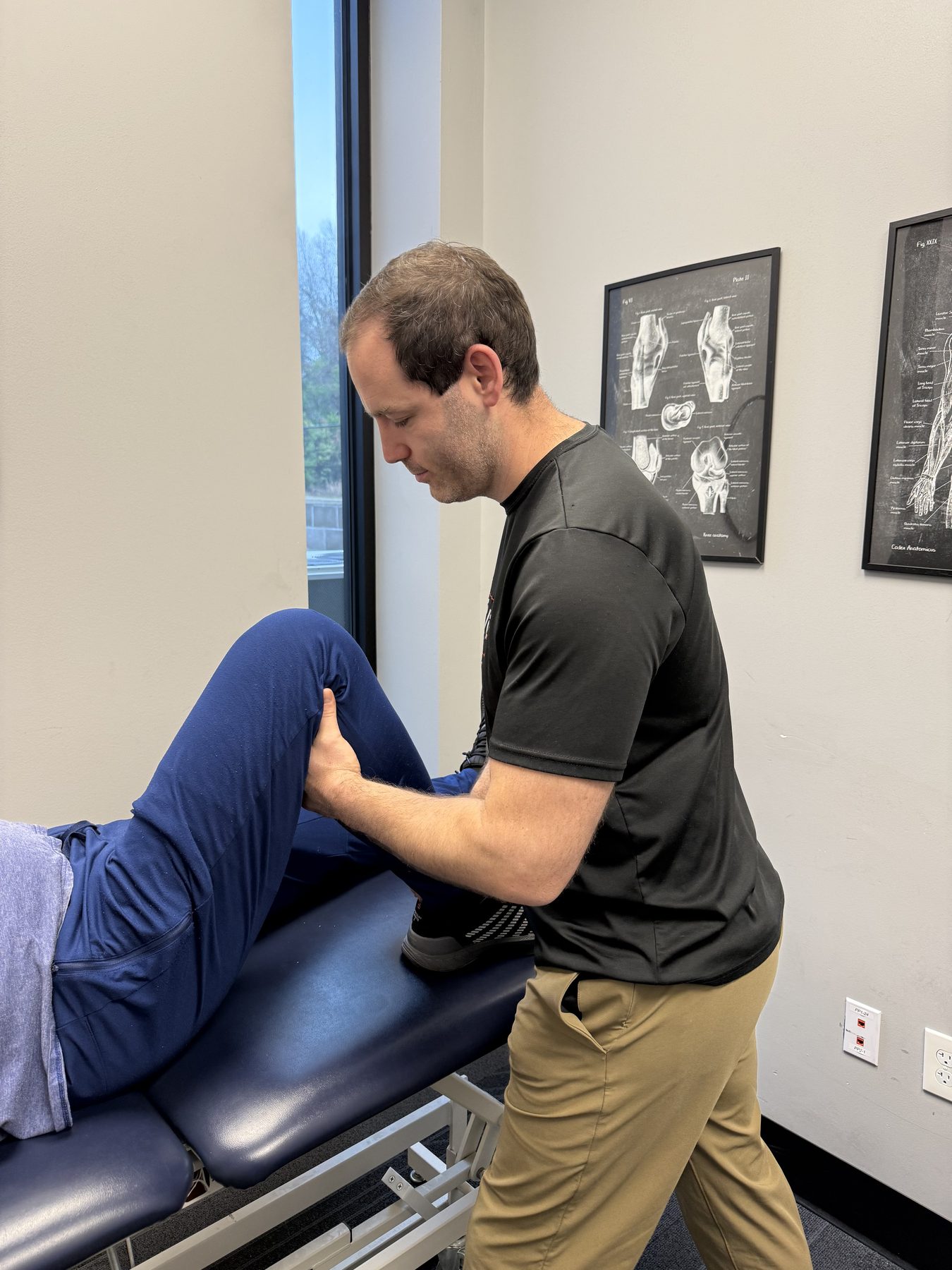
The lumbar disc is a pressurized cushion with a soft nucleus inside a fibrous ring. Bending forward compresses the front of the disc and pushes the nucleus backward toward the spinal nerve roots. If the back ring is weakened or already bulging, repeated flexion makes the bulge bigger, not smaller.
Common flexion stretches that backfire on a disc patient.
- Toe touches.
- Seated forward fold.
- Knees to chest.
- Child's pose.
- Happy baby.
- Any stretch where you flex the spine to touch something.
These feel good for about 20 seconds because they temporarily decompress the posterior tissues. They then worsen the underlying driver.
Why your body wants to stretch
During a disc flare, the muscles around the spine guard. You feel tight. The instinct is to stretch. The tightness is not short muscles. It is the nervous system protecting the injured disc. Stretching the guard stretches the disc.
You address the muscles by addressing the disc. Directly going after the"tight" muscles makes both worse.
What to do instead. Directional preference
Robin McKenzie's central insight. most disc patients have a direction of motion that centralizes the symptoms (moves them out of the leg and up into the back). For about 80 percent of disc patients, that direction is extension.
Extension work is not stretching in the usual sense. You are not lengthening a tight muscle. You are repeatedly moving the spine in the direction that encourages the disc material forward, away from the nerve. Done consistently over days, it is the most effective self treatment we know for a posterior disc bulge, and it is the backbone of the program below.
The 14 day extension program
This is the staged progression we prescribe for extension responders. Each stage earns the next. If a stage increases your leg symptoms, drop back to the previous stage for two more days before trying again.
Stage 1. Prone lying (days 1 to 3)
Lie face down on a firm surface with your arms at your sides. Stay there five to ten minutes, three to four times a day. If lying flat is too intense at first, place a pillow under your hips and remove it as you adapt. If leg pain eases while you lie there, you are responding to treatment.
Stage 2. Prone on elbows (days 3 to 7)
Face down, propped on your forearms like you are reading a book. Relax everything below the ribs and breathe. Hold one to two minutes, then lower. Work up to ten repetitions spread across the day. Watch the response closely. Pain moving toward your spine is progress. Pain spreading down the leg means stop and return to stage 1.
Stage 3. Press ups (days 7 to 14)
Start face down with your hands under your shoulders. Straighten your arms and lift your chest while your hips stay on the floor. Hold one to two seconds at the top, then lower with control. Ten reps per set, six to eight sets per day.
Standing backward bend (any stage)
Stand, place your hands on your low back, and arch backward as far as comfortable. Ten reps every hour at work. This is the portable version of the program for the hours you cannot get on the floor.
The stop rules apply at every stage. Leg pain that intensifies or travels farther down, new numbness, or new weakness means stop the program and book an evaluation. A small subset of disc patients have a flexion directional preference, which needs clinical identification. If these movements centralize your symptoms (reduce leg pain, move pain closer to the spine), you are on the right track.
After day 14, the program does not simply end. Press ups drop to a maintenance dose (one or two sets a day, plus a set after any aggravating activity) while loaded rehab takes over as the main event. The extension work got the disc off the nerve. Loading is what rebuilds the capacity that keeps it there, and it is covered two sections down.
What is centralization and why does it matter?
Centralization is your symptoms retreating from the foot or leg back toward the spine, and it is the single most useful sign in disc rehab. Patients whose symptoms centralize during repeated movement testing have about a 95 percent chance of avoiding back surgery. It tells us the disc material is moving off the nerve and that the direction we picked is the right one.
Expect a trade you might not love at first. back pain sometimes increases while the leg symptoms recede. That trade is a win. A typical centralizing course looks like this.
- Week 1. Back pain plus foot numbness.
- Week 2. Back pain plus calf numbness. The symptoms are climbing.
- Week 3. Back pain plus buttock pain only.
- Week 4. Back pain only. From here the back pain itself fades as the tissue calms.
The reverse pattern (peripheralization) is the alarm. Symptoms moving farther down the leg, spreading to the second leg, or new numbness anywhere means the current strategy is wrong for your spine. Stop and get evaluated. Direction testing is a core part of the initial evaluation, and it is the fifteen minutes that determines the next six weeks.
Do most disc bulges heal without surgery?
Yes. Between 73 and 90 percent of disc herniations resolve without surgery when treated with evidence based physical therapy. In published McKenzie method outcomes, roughly 85 percent of disc bulge patients improve with the right directional program, and 73 percent of surgical candidates avoid the operation entirely. The disc itself participates. follow up imaging shows bulged and herniated material shrinking over months as the body resorbs it.
Surgery still has a clear lane. progressive weakness, bowel or bladder changes, or intractable pain past three months of proper rehab. For everyone else, the conservative path wins on risk and matches on outcome.
Set your timeline expectations accordingly. Centralization usually starts inside the first week. Meaningful function returns over six to ten weeks. The disc material itself keeps remodeling for months after you feel normal, which is why the loading phase below is not optional even when the pain is gone.
What about the leg pain? Sciatic nerve glides
When the disc is calming but the leg still aches or tingles, the sciatic nerve itself often needs attention. Nerve glides (flossing) restore the nerve's ability to slide through the tissues around it without stretching it. The head and the ankle move together on purpose. the pairing slides the nerve through its tunnel instead of pulling it tight from both ends.
- Lie on your back with one knee bent and the painful leg straight.
- Slowly pull the toes of the straight leg up toward your shin while you tilt your head back.
- Then point the foot away while you bend your head forward, chin toward chest.
- Repeat 10 to 15 slow cycles, once or twice a day.
The rule. no leg pain during the movement. A gentle pulling sensation is acceptable. Sharp or electric pain means stop. If glides consistently provoke symptoms, the nerve is still too irritable and the disc work needs more time first.
Timing matters here. Glides belong in the second week and beyond, once the extension program has started centralizing your symptoms. Starting nerve work while the disc is still actively pressing on the nerve tends to stir things up rather than settle them.
How should you sit and sleep during a flare?
Sit as little as possible in week one, and support the natural curve when you must. Sitting is the highest sustained disc load of any daily position.
- Place a small rolled towel or lumbar roll behind your low back at belt height.
- Stand and reset every 15 to 20 minutes. Ten standing backward bends after any long sit.
- Avoid soft couches and low chairs. They pull the spine into flexion.
- Driving counts as sitting, with vibration added. Set the seat back slightly reclined, use the roll, and break up drives longer than 30 minutes during the first two weeks.
At night, position the spine so the leg stays quietest.
- Back sleepers. pillow under the knees.
- Side sleepers. pillow between the knees, lying on the less painful side.
- Stomach sleeping is acceptable during a disc flare if it clearly reduces leg symptoms. It is essentially prone lying, the stage 1 position.
For the complete positional playbook, see 5 Positions to Reduce Disc Bulge and Sciatic Pain.
Load before you stretch
Once the acute flare settles (usually two to three weeks), the path forward is loaded rehab, not stretching.
- Dead bug and bird dog for core stability.
- Glute bridge and hip thrust.
- Hinge pattern (deadlift) starting unloaded.
- Squat pattern, box squat to start.
- Walking, progressively longer bouts.
The spine is a structure built to bear load. Restoring tolerance to load is what resolves the chronic pattern.
When it is not the disc
Not every back pain is disc. Facet joint pain, sacroiliac joint dysfunction, and muscular strain respond differently. Some respond well to flexion. Getting the diagnosis right in the first visit determines what the next six weeks look like. A DPT evaluation sorts this in 15 minutes.
Red flags. Do not self treat
- Loss of bladder or bowel control.
- Saddle numbness.
- Progressing leg weakness.
- Fever with back pain.
Frequently asked questions
What is the difference between a bulging disc and a herniated disc?
A bulging disc means the outer ring is weakened and pushed outward but still intact. A herniated disc means the ring has torn and some of the inner gel has escaped. Both respond to the same directional program in most cases, and both can centralize. The label matters less than your direction of preference.
Should I stop stretching entirely?
During a disc flare, avoid flexion based stretches. Extension and gentle walking are your tools. Later in recovery, targeted mobility work returns.
What about yoga?
Most classes include heavy flexion. Work with a teacher who can modify or pause during a flare.
Will I always need to avoid these stretches?
No. Once the disc resolves and the spine tolerates load, full range mobility returns safely.
How fast will I know if this is working?
Centralization usually happens inside the first week. Full resolution takes six to ten weeks.
What if extension makes me worse?
Book an evaluation. You may have a different directional preference or a different diagnosis.
Book the evaluation
initial evaluation with Tim Hu, PT, DPT, OCS, C-DN. Book online.
References
- Lam OT, et al. Effectiveness of the McKenzie method of mechanical diagnosis and therapy for treating low back pain: literature review with meta analysis. J Orthop Sports Phys Ther. 2018;48(6):476-490.
- May S, et al. Centralization and directional preference: an updated systematic review. Musculoskelet Sci Pract. 2018;38:53-62.
- Garcia AN, et al. Effectiveness of back school versus McKenzie exercises in patients with chronic nonspecific low back pain: a randomized controlled trial. Phys Ther. 2013;93(6):729-747.
- Szulc P, et al. Impact of McKenzie method therapy on subjective and objective parameters related to spine function in patients with chronic low back pain. Med Sci Monit. 2015;21:2918-2932.