In short
If you deadlift heavy, the single best back protection is the barbell Jefferson curl, programmed conservatively. Not because it is a miracle move, but because it trains the spine to tolerate loaded flexion, which every deadlift produces in small doses. Add a second exercise, the standing cable anti rotation press, for bracing. Together they build the resilience your spine needs when a rep goes slightly sideways. At Physio+ Sport Performance in Lindale and Tyler, we program these with the lifters we work with.
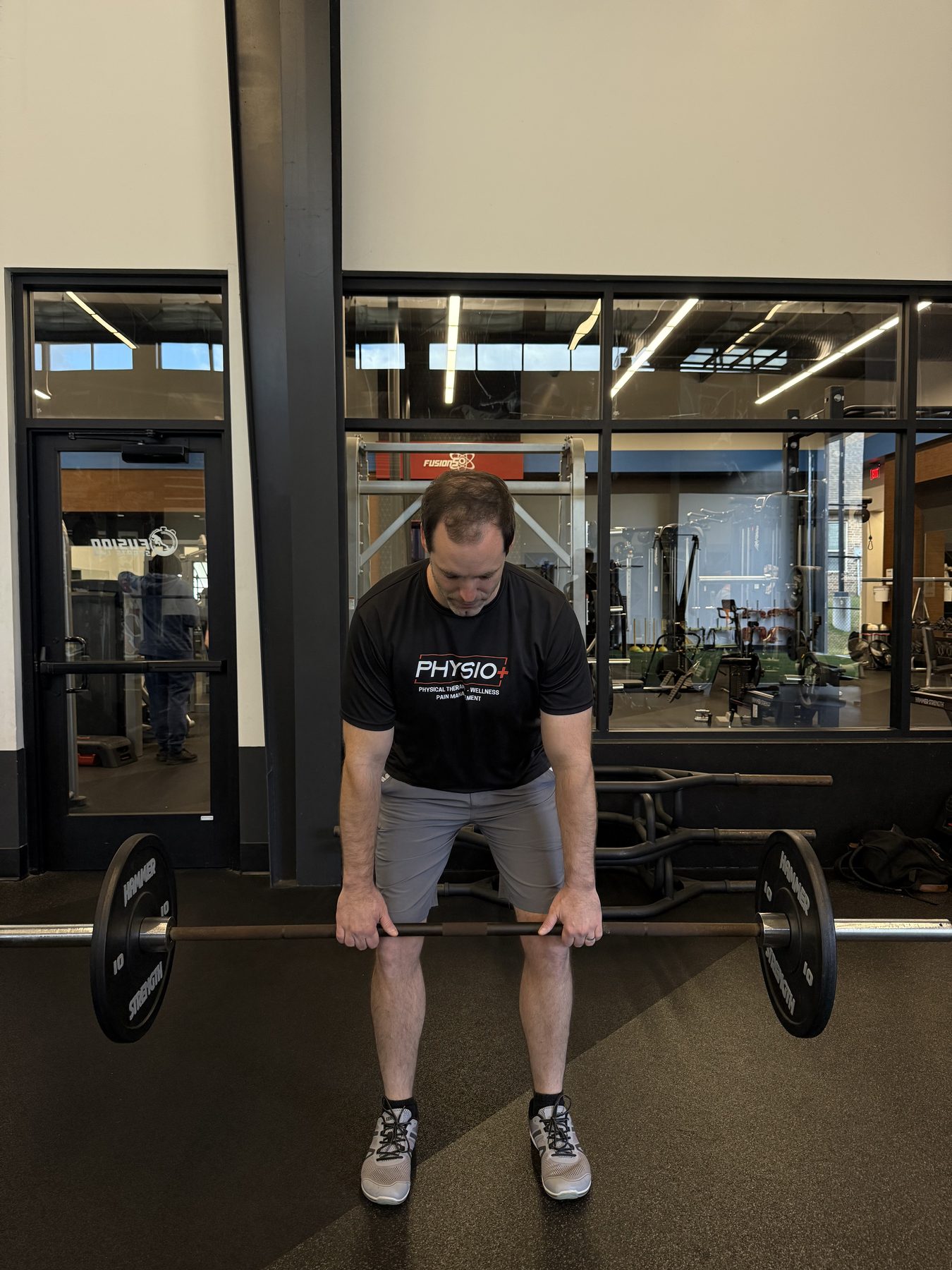
How common is back pain in deadlifters?
More common than most lifters admit. Over 60 to 70 percent of strength athletes report low back pain at some point in their lifting career. That number is not an argument against deadlifting. It is an argument for preparing the spine for the sport instead of hoping technique alone protects it. The lifters who train spinal capacity directly are the ones who stay out of that statistic.
Why the usual advice fails
Most online back protection advice says"brace harder" and"keep a flat back." Both are correct and both are incomplete. You can brace perfectly for 95 percent of your reps. On the fifth rep of a heavy set, your back will round a little. That micro flexion is normal and not the cause of injury, unless your spine is untrained for it.
Training the spine to tolerate small amounts of loaded flexion with full control is the difference between a lifter who tweaks their back every third training block and a lifter who does not.
The Jefferson curl, dosed correctly
Stand on a box, light dumbbell or kettlebell in both hands. Roll the spine down vertebra by vertebra, letting the weight hang below your feet. Then roll back up the same way. Slow. Three seconds down, one second pause, three seconds up.
Progression.
- Week 1 to 2. 15 pound dumbbell. 3 sets of 5. Full range, slow tempo.
- Week 3 to 4. 25 pounds. 3 sets of 5.
- Week 5 to 8. Add 5 pounds per week as long as form is flawless.
- Never take this past 40 percent of your best deadlift weight. It is a capacity builder, not a max lift.
Twice a week, on non deadlift days. Ease back during meet preparation or heavy peak weeks.
The anti rotation press
Cable or band at shoulder height, set up perpendicular to your body. Press the cable straight out in front of you, pause, return. The cable will try to rotate you. Your core's job is to refuse.
Three sets of 10 per side, medium load, three times a week. This is the bracing complement that teaches your core to hold rigid under rotational demand, which every walk out and every descent from a deadlift produces.
Where does the McGill curl up fit?
On your stiffness days, and in your program alongside the Jefferson curl, not instead of it. The McGill curl up comes from Dr. Stuart McGill's big 3, the most studied core stability sequence in the low back literature. Where the Jefferson curl teaches the spine to tolerate motion under load, the curl up teaches it to refuse motion under load. Deadlifting demands the second skill on every rep: the spine stays stable while force transfers through it. The curl up trains your core to brace, not move, without irritating the discs.
How to do it. Lie on your back with one knee bent and the other leg straight. Slide your hands under your low back to preserve the natural arch. Brace your core as if preparing to pull. Lift your head and shoulders slightly, without flattening your back, and hold for 10 seconds. Five to ten reps per side, three to four times per week. Focus on tension, not movement.
An honest note on the two philosophies. The McGill school holds that the lifting spine performs best when trained to resist flexion, so you build stiffness and endurance and keep motion out of the lift entirely. The loaded flexion school holds that the spine adapts to what it is gradually exposed to, so you prepare it for the small amounts of rounding heavy pulling produces anyway. The research has not crowned a winner, and in our clinic they answer different questions. We bias the curl up during heavy training blocks, meet preparation, and early rehab, when you want maximum stiffness and zero added spinal fatigue. We bias the Jefferson curl in pain free lifters during lower load phases, when building flexion tolerance is the goal. Run both and your spine gets both capacities.
What it does for your deadlift
- Your spine tolerates micro flexion without panic.
- Your bracing strategy holds longer inside a heavy set.
- Your recovery between training sessions improves because the tissue is more resilient.
- Your risk of tweaking your back during a normal lift drops substantially.
What not to do
- Rush the Jefferson curl load. The tempo and range are the point.
- Use a belt for it. This exercise is about raw spinal capacity.
- Add volume faster than your recovery allows.
- Run this in the week before a meet.
When to stop and see a PT
If you have current back pain, especially with radiating leg symptoms, do not start these on your own. A DPT evaluation identifies whether you have a disc, facet, or muscular driver and what loading is safe. Most lifters are back to full training inside four to six weeks.
How this fits a Physio+ plan
At Sport Performance, Cameron Berry, PT, DPT, CSCS, SMTC builds programs that integrate rehab, capacity, and your specific sport. For powerlifters, Olympic lifters, and CrossFit athletes, the Jefferson curl and anti rotation press are staples once the mainlifts are dialed.
Frequently asked questions
Is rounding my back bad?
Loaded, uncontrolled rounding under a max lift is risky. Small, trained, controlled flexion under submaximal load is what the spine is designed to tolerate.
How often should I do these?
Twice a week for the Jefferson curl, three for the anti rotation press. Scale down during meet prep.
Will this help my squat?
Yes. The same spinal capacity and bracing carry over.
Can I do these with existing back pain?
Not until you have been cleared. Book the evaluation first.
What if I do not compete?
Same principle applies. If you pull heavy relative to your body weight, these protect you.
Should I run the McGill curl up or the Jefferson curl?
Both, on different days. The curl up builds stiffness and bracing endurance. The Jefferson curl builds flexion tolerance. They train opposite capacities and your deadlift uses both.
Book the evaluation
Performance evaluation with Cameron Berry, PT, DPT, CSCS. initial evaluation, ninety minutes. Book online.
References
- McGill SM. Low Back Disorders: Evidence Based Prevention and Rehabilitation. 2nd ed. Human Kinetics; 2007.
- Bahr R, Krosshaug T. Understanding injury mechanisms: a key component of preventing injuries in sport. Br J Sports Med. 2005;39(6):324-329.
- Steele J, Bruce-Low S, Smith D. A review of the clinical value of isolated lumbar extension resistance training for chronic low back pain. Phys Ther Rev. 2014;19(2):96-107.
- Hides JA, Stanton WR, McMahon S, Sims K, Richardson CA. Effect of stabilization training on multifidus muscle cross sectional area among young elite cricketers with low back pain. J Orthop Sports Phys Ther. 2008;38(3):101-108.